

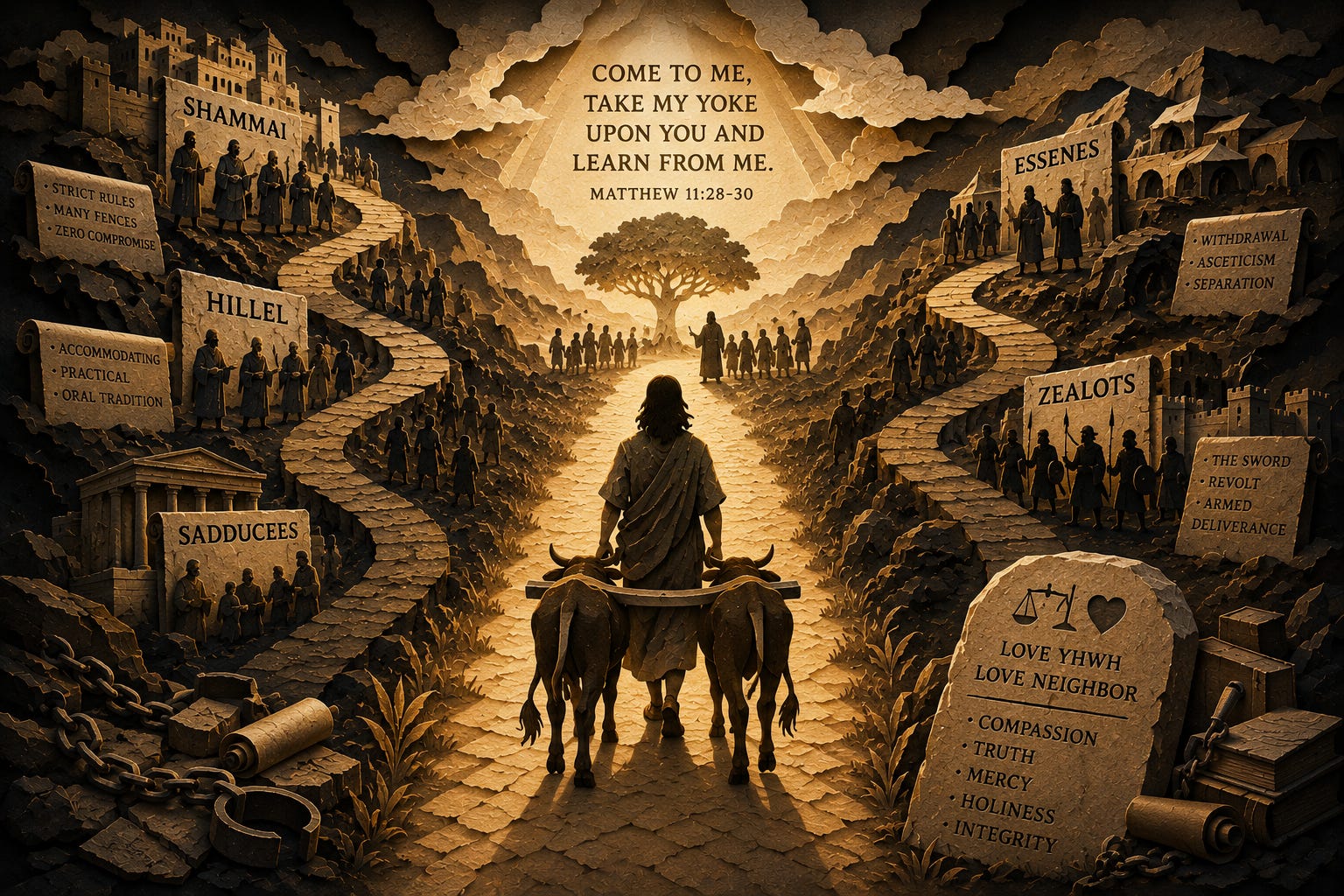
When most modern readers hear Yeshua say
“take my yoke upon you,”
the image lands softly and disappears. Maybe an ox in a field. Maybe a vague spiritual burden. The line gets quoted and slips by.
That is not what his first listeners heard.
In the first century, a yoke was a way of addressing the Torah. It was a rabbi’s framework for how Torah was to be lived out in daily life. To take on a rabbi’s yoke meant committing yourself to his interpretation, walking in his way, joining his movement. It shaped how you kept Shabbat, how you tithed, how you ate, how you prayed, how you married, how you handled outsiders, even how you understood Rome. The yoke you wore announced to your neighbors which rabbi had your loyalty and which reading of the Torah you trusted with your life.
This is what made Yeshua’s invitation so charged. He was not offering an inspirational thought. He was calling people out of the yokes they already wore and asking them to take his instead. Every rabbi in the land was offering a yoke, and every one of them claimed to be the right way to honor the God of Israel.
The same thing is happening to us today, though we rarely recognize it. The yokes have new names. We call them denominations. We call them traditions. We call them styles of faith. The structure is the same. Each one offers its own framework for addressing the Torah, for living the Scripture, for being the people of God. And just like the crowds of the first century, the question for every believer remains the same. Whose yoke are you actually wearing?
Once we see what those yokes actually were, Yeshua’s invitation lands with the weight it originally carried.
Scripture
“Come to Me, all who are weary and heavy laden, and I will give you rest. Take My yoke upon you and learn from Me, for I am gentle and humble in heart, and you will find rest for your souls. For My yoke is easy and My burden is light.”
These three verses are the heart of the lesson. Yeshua spoke them in the middle of a moment of growing conflict in his ministry. He had just denounced the cities that refused to repent. He had just thanked the Father for revealing the Kingdom to the simple and hiding it from the wise. And then he turned to the crowd and offered something none of his contemporaries were offering.
To hear the weight of his words the way his audience did, set them against the kind of yoke they were actually wearing. Yeshua himself described it directly in another moment of his ministry:
“They tie up heavy loads and lay them on people’s shoulders, but they themselves are not willing to lift a finger to move them.”
The yokes Israel was wearing were crushing. The one Yeshua offered would not be.
Context
Five major streams or yokes shaped the religious imagination of first-century Israel. Each had its own teachers, its own followers, and its own conviction that it represented the true way of being faithful to YHWH. To grasp the radical nature of what Yeshua offered, the reader has to first see what was already on offer.
1. The Yoke of the House of Shammai (the rigid Pharisees)
The school of Shammai held majority political influence during Yeshua’s youth and early ministry. Their yoke was famously heavy, restrictive, and zero-compromise. They built fences around the Torah, then fences around those fences. They were stricter than Hillel on Shabbat boundaries, on the acceptance of converts, on relations with Gentiles, on tithing, and on divorce.
Their yoke was animated by zeal for the purity of Israel and resistance to anything that might compromise it. They held, for example, that audible prayers for the sick on Shabbat detracted from the joy of the holy day and should be restrained. They taught that divorce was permitted only for sexual immorality, a position Yeshua himself affirmed in Matthew 19:9.
When the Gospels describe Yeshua in conflict with “the Pharisees” over Shabbat or ritual purity or the treatment of sinners, he is often engaging positions associated with the stricter Shammai stream. The Shammai yoke had a nationalistic edge that some scholars connect to the later zealous resistance movements. To wear it was to live in constant guardedness, every motion checked against an inherited code of fences.
2. The Yoke of the House of Hillel (the lenient Pharisees)
The school of Hillel the Elder was more accommodating to ordinary people and more pastoral in its application of Torah. Hillel famously summarized the Torah for a Gentile seeker in a single sentence: “What is hateful to you, do not do to your neighbor. That is the whole Torah. The rest is commentary. Go and learn it.” Beit Hillel looked for ways to make Torah livable for the common Jew who could not master every detail of the oral tradition.
But “lenient” did not mean “light.” The Hillel yoke still required mastery of a vast web of oral rulings, legal definitions, and applications that required meticulous daily navigation. Sha’ul (the apostle Paul) was trained at the feet of Gamaliel, grandson of Hillel and a leading voice of Beit Hillel (Acts 22:3). His education was serious and his obligations were substantial.
Together, Shammai and Hillel formed the two streams of the broader Pharisee movement, the dominant religious force shaping daily Jewish life. The Pharisees believed in the oral Torah handed down alongside the written, in the resurrection of the dead, in angels and the world to come, and in a coming Messiah who would restore Israel. They were laymen rather than priests, synagogue teachers rather than temple officials, and the most popular religious party with ordinary Jews.
3. The Yoke of the Sadducees (the aristocratic priests)
The Sadducees controlled the temple in Jerusalem and the wealthy political elite. Their yoke held tightly to the written Torah of Moses alone, rejecting the Pharisaic oral tradition. They denied the resurrection of the dead, the developed doctrine of angels, and the elaborate vision of the world to come that the Pharisees held (Acts 23:8).
Their yoke focused on maintaining temple rituals, preserving institutional wealth, and cooperating politically with the Roman occupiers to keep their position secure. For the ordinary Jew, the Sadducean yoke was largely about temple participation and festival observance. It did not reach into daily life the way the Pharisaical yokes did, but it carried the gravity of the temple itself. When the temple fell in 70 CE, the Sadducean yoke fell with it. They have no surviving heirs.
4. The Yoke of the Essenes (the desert ascetics)
The Essenes believed the temple in Jerusalem had become hopelessly corrupt and the priesthood illegitimate. Their yoke was one of withdrawal. They formed communal settlements, the most famous being Qumran by the Dead Sea (the community associated with the Dead Sea Scrolls), where they practiced radical asceticism, shared all property, immersed daily in ritual baths, and waited for an apocalyptic war between the Sons of Light and the Sons of Darkness.
The Essene yoke was the heaviest in terms of life rearrangement. To take it on, you walked away from ordinary life entirely. Some scholars believe John the Baptist was influenced by Essene-adjacent thinking. Whether or not the connection was formal, the resemblance is real.
5. The Yoke of the Zealots (the political insurgents)
The Zealot impulse held that accepting Roman rule and paying taxes to Caesar was a direct violation of the yoke of the Kingdom of Heaven. Their yoke was defined by militant, often violent, resistance. They believed God would not send the Messiah until Israel took up the sword and forcibly purged the Romans and their Jewish collaborators from the holy land.
The movement crystallized into a formal party in the years leading to the Jewish war of 66 to 70 CE, but the impulse was alive throughout Yeshua’s ministry. Simon called the Zealot was among Yeshua’s twelve disciples (Luke 6:15), so the impulse touched even his inner circle. The militant hope of deliverance through the sword ended in catastrophe. The Romans crushed the revolt and destroyed the temple.
The crowd crushed under these yokes
Picture the audience listening to Yeshua. The vast majority of Jews in the first century were not Pharisees, not Sadducees, not Essenes, not Zealots. They were the am ha’aretz, the people of the land. Fishermen on the Sea of Galilee. Farmers in the countryside. Day laborers. Shepherds. Widows. Tax collectors. The chronically ill. Women whose husbands had abandoned them. Lepers.
These people could not master the elaborate oral tradition of the Pharisees. They could not afford the full tithing pattern the rabbis specified. They could not abandon their work for the daily prayers at the fixed hours. They could not keep up with the purity codes the Shammaites required. They were dismissed by the religious elite as ignorant and unclean.
This is the crowd Matthew describes when he writes that Yeshua saw the people and was moved with compassion because they were harassed and helpless, like sheep without a shepherd (Matthew 9:36). The shepherds of Israel were arguing in their academies about whose yoke was the true one, and the sheep were dying in the fields trying to carry yokes that crushed them.
This is the moment Yeshua stepped forward and said: come to me.
Why his yoke methodology was radical
Against that backdrop, the radical nature of what Yeshua offered comes into focus. His yoke broke the pattern of every other rabbi in the land in one fundamental way. He held together what every other yoke split apart.
Each of the five yokes had picked one side of a polarity and made it the whole thing. Shammai chose strictness without compassion. Hillel chose accommodation without prophetic challenge. The Sadducees chose institutional power without sacrificial engagement. The Essenes chose separation without involvement. The Zealots chose judgment without mercy. Each yoke was a half-truth pretending to be the whole. Each one took a part of how YHWH deals with his people and elevated it to the exclusion of everything else.
Yeshua did not pick a side. He welcomed the woman caught in adultery and told her to sin no more. He looked at the rich young ruler with love and told him to sell everything he had. He blessed the children and named the seven woes of the Pharisees to their faces. He healed the leper and warned the unrepentant city. He overturned the tables in the temple and wept over the city where the tables stood. He spoke gently to Nicodemus by night and cuttingly to the Sanhedrin by day. His yoke carried compassion and confrontation in the same breath. It welcomed sinners and demanded holiness. It honored Torah and confronted the fence-builders. It was integrated where every other yoke was split.
The wholeness of his yoke shaped everything else about it.
He did not pile more rules on top of the existing ones. Every other yoke worked by addition. Shammai added fences. Hillel added flexible workarounds inside the fences. The Sadducees added political compromise. The Essenes added withdrawal. The Zealots added the sword. Yeshua moved in the opposite direction. He drove every commandment to its root and summarized the entire Torah in two commandments: love YHWH with everything you are, and love your neighbor as yourself. On these two, he said, hang the entire Torah and the Prophets (Matthew 22:37-40). The yoke had a spine. When the spine was intact, the body moved.
He welcomed the people every other yoke excluded. He ate with tax collectors and sinners. He touched lepers. He spoke to a Samaritan woman in broad daylight by a well. He let a woman of the city anoint his feet. He held up children as the model for the Kingdom. Every other yoke in Israel measured a person’s worth by their ability to perform the system. Yeshua measured a person’s worth by their willingness to come.
He carried the yoke with the disciple rather than laying it on them. The other yokes were external systems imposed from above. Yeshua’s yoke was a paired yoke. He was the older ox who already knew the field. He walked in step with anyone who would walk with him, and he carried the heavier share.
He pointed to himself rather than to a system. Every other rabbi pointed to a tradition, a school, a sage, a method. Yeshua said come to me and learn from me. The yoke was relational at its core. To take his yoke was to walk with him, not to memorize his rulings.
He produced rest rather than exhaustion. The promise was menuchah, the settled stillness Shabbat had always rehearsed. The other yokes left people weary. His yoke, well-fitting by design, restored the soul.
He was not adding a sixth yoke to the five already on offer. He was offering a different kind of yoke altogether. One that held the whole. One that fit. One he carried with you. One that took the heart of Torah and gave it back to the people the religious system had crushed.
If his yoke was not more rules and not the abolition of the Torah either, then what was it actually made of? The answer takes us straight to his life. That is where we go next.
Covenant
The radical thing about Yeshua’s yoke is that it did not abolish the Torah. It revealed how the Torah was always meant to be carried.
He said it himself in the clearest words he ever spoke on the subject:
“Do not think that I came to abolish the Torah or the Prophets! I did not come to abolish, but to fulfill. Amen, I tell you, until heaven and earth pass away, not the smallest letter or stroke shall pass away from the Torah until all things come to pass. Therefore, whoever shall break one of the least of these commandments and teach others to do so shall be called least in the kingdom of heaven; but whoever keeps and teaches them, he shall be called great in the kingdom of heaven.”
That statement closes off two false readings before they can take root. The first false reading is that Yeshua came to give us something other than the Torah, some new spiritual system that replaces what came before. The second false reading is that he came to add a heavier yoke of rules on top of what was already there. Neither is what he said. He said he came to fulfill.
What “fulfill” actually means
The Greek word pleroo carries the sense of filling up, completing, bringing to its intended fullness. In Hebrew thinking, to “fulfill” a commandment did not mean to discard it after performing it. It meant to embody it correctly, to live it the way the Giver of the commandment had always intended it to be lived. A rabbi who “fulfilled” the Torah was a rabbi whose interpretation captured the heart of what YHWH was actually after.
In that sense, Yeshua fulfilling the Torah meant something deeper than checking boxes on commandments. It meant his entire life became the demonstration of what Torah was always pointing at. His way of keeping Shabbat showed what Shabbat was for. His way of loving the unlovable showed what the holiness code was for. His way of forgiving showed what the sacrificial system was for. His way of going to the cross showed what every Pesach lamb had been rehearsing for centuries.
He did not abolish a single commandment. He completed them by living them as the Father had always wanted them lived.
His life as the template
This is what makes Yeshua’s yoke different from every other rabbi’s yoke. The other rabbis pointed to their interpretation. Yeshua pointed to himself. When he said “take my yoke upon you and learn from me,” he was offering his own life as the template for how Torah is to be addressed.
Look at how he addressed the Torah and you see the yoke he offers.
He kept Shabbat. He observed it from the heart rather than from the fence-builders’ codebook. He healed on Shabbat. He gathered grain on Shabbat. He declared that Shabbat was made for man and not man for Shabbat (Mark 2:27). His way of keeping the day did not erase the commandment. It restored its purpose.
He kept the appointed times. He went up to Jerusalem for the festivals. He celebrated Pesach with his disciples on the night before he died. He chose his death so precisely that it landed on Pesach, his burial on the day of Matzah, his resurrection on the day of Firstfruits, and the giving of his Spirit on Shavuot fifty days later. Every spring festival was fulfilled in him with exact timing. The festivals were not erased. They were completed in his body.
He honored the Tanakh as the word of his Father. He quoted Torah, Prophets, and Psalms constantly. He resisted the adversary in the wilderness with words from Deuteronomy. He read Isaiah aloud in his hometown synagogue and announced its fulfillment in himself (Luke 4:16-21). He explained his death to the disciples on the road to Emmaus by walking them through Moses and all the Prophets (Luke 24:27). His own teaching was steeped in the Scripture his Father had given Israel for fifteen hundred years.
He embodied the great commandments. He loved YHWH with all his heart, soul, mind, and strength. He loved his neighbor as himself, including the neighbors his society had written off. He loved his enemies. He prayed for those who killed him. He laid down his life for those who hated him. The two commandments on which the entire Torah and the Prophets hang were not a slogan in his mouth. They were the shape of his body.
He walked in the Ruach (the Spirit). He was led by the Spirit into the wilderness. He taught in the power of the Spirit. He healed by the Spirit. He went to the cross through the eternal Spirit (Hebrews 9:14). His relationship with the Father was constant and intimate. He prayed often, alone and with others. He withdrew to be with the Father and returned to the people.
This is the template. The yoke he offers is not a code to memorize. It is a life to imitate. To take his yoke upon you is to learn how he addressed the Torah and to address it the same way.
The promise underneath the yoke
The yoke Yeshua offered was not new in its content. The Torah he embodied was the same Torah Moses had received at Sinai. What was new was the way it would now be carried.
Centuries before, Jeremiah had promised the day was coming when YHWH would write the Torah on the heart of his people:
“But this is the covenant I will make with the house of Israel after those days,” declares Adonai. “I will put My Torah within them. Yes, I will write it on their heart. I will be their God and they will be My people.”
This is the covenant Yeshua came to inaugurate. The same Torah, the same instruction the Father gave at Sinai, would now be written on the inside instead of carved on stone tablets. The Ruach he poured out on the disciples at Shavuot was the writing instrument. The yoke was not the elaborate oral tradition of the Pharisees or the fences of the Shammaites. It was the Torah itself, alive inside the believer, carried in step with the Messiah who embodied it first.
His yoke takes us into the Torah, not away from it. His yoke connects us to Moses, to David, to Isaiah, to Jeremiah. His yoke makes the Tanakh into the soil our faith grows out of. To wear his yoke is to find the Old Testament becoming new again, not because it was ever obsolete but because the Spirit now opens it from the inside.
The same drama playing out today
The yokes Israel faced in the first century are not the only yokes that ever existed. Every age produces its own. The names have changed but the structure has not.
Today we call them denominations. We call them traditions. We call them theological streams. Some are stricter, some are looser. Some emphasize doctrine, some emphasize experience, some emphasize social action, some emphasize separation from the world. Each one offers a framework for how to live the Scripture, and each one shapes its members in the same ways the rabbinical yokes shaped first-century Jews. The yoke decides which Bible verses get emphasized and which get skipped. The yoke decides which day is treated as holy and which days are not. The yoke decides which practices are required, which are tolerated, and which are condemned. The yoke decides who is in and who is out.
The danger inside many modern yokes is the same danger the first-century yokes carried, with one added twist. Many modern yokes pull believers away from the Torah rather than into it. They treat the Tanakh as historical background to the real story rather than as the living word of the Father that Yeshua himself loved. They replace Shabbat with another day. They replace the appointed times with festivals the Father never authorized. They reduce discipleship to doctrinal agreement and treat the way a person actually lives as optional once the right beliefs are recited. They build their own fences, their own oral traditions, their own distinctives, and lay them on people’s shoulders as if those fences were the yoke of Yeshua.
This is not an accusation against any particular group. It is a description of the same gravitational pull that pulled the rabbis of the first century into yokes that did not fit. Religious systems drift. They drift in every century. The question for the believer is never whether the system has drifted. The question is whether you have noticed.
The question the lesson lays at your feet
Yeshua’s yoke is still on offer. It has not been improved on. It has not been outgrown. It has not been replaced by anything better. The same invitation he extended to the crowds in Galilee stands today in the same words.
Come to me. Take my yoke upon you. Learn from me.
The yoke is the Torah lived the way he lived it. The template is his life. The companion in the yoke is his Spirit. The destination is the rest the world cannot give.
The question every believer has to answer is which yoke they are actually wearing. Not the one written on their statement of faith. Not the one printed in the bulletin. The one their actual life is shaped by. Whose interpretation is forming your week? Whose pattern is shaping your loves and your fears? Whose dust is on your sandals at the end of the day?
If the honest answer is not Yeshua, the invitation is still there. He still says come. What follows is a way to start walking with him this week.
Practice
A Picture from Today
You may have lived your whole Christian life without ever realizing you are wearing a yoke.
Consider your last week. Which day did you treat as holy, and why that day? What Scriptures did you read, and which ones did you skip past? What holidays shape your calendar, and which ones do not? What practices define your faith, and who decided they would?
If you are honest, most of those answers were never up for a vote. You inherited them. You walked into a tradition that had already shaped a yoke and was ready to hand it to you. The choices about which day, which Bible passages, which holidays, and which practices had already been made by previous generations. You were given the yoke and told to wear it.
That is the nature of a yoke. It feels like normal Christianity. It feels like just reading the Bible. It feels like simply being a believer. But it is a framework, and the framework came from somewhere.
Two believers living on the same street may both love Yeshua deeply, read the same Bible, pray to the same Father, and yet have weekly lives that look almost nothing alike. One worships on Sunday. The other on Shabbat. One celebrates Easter. The other observes Pesach. One has never heard a sermon from the Torah portion of the week. The other arranges his whole year around the moedim of Leviticus 23. Neither of them sat down at the beginning of their walk and chose those frameworks on purpose. Both inherited them. Both are wearing yokes.
Most of us have no idea this is happening. The yoke is invisible until somebody names it. Once it is named, the only real question left is whether the yoke you have been wearing is the one Yeshua himself wore.
This lesson is about seeing the yoke you have been handed, holding it up to the life of the Messiah, and deciding whether it is time to take a different one.
Three Key Takeaways
1. A yoke in the first century was not a metaphor for burden. It was a rabbi’s framework for how to live the Torah, and joining a rabbi meant joining his movement. The yoke shaped Shabbat, prayer, meals, marriage, money, and politics.
2. Yeshua came to fulfill the Torah, not to abolish it. His life is the template for the yoke he offers. His Spirit is the means by which the Torah is now written on the heart. His yoke takes us into the Tanakh, not away from it.
3. The same dynamic plays out today. Modern denominations and traditions function as yokes, shaping believers the same way the rabbinical schools shaped first-century Jews. The honest question every believer must answer is which yoke is actually forming their daily life.
Three Discussion Questions
1. When you look honestly at how your week is shaped (what you do on Shabbat, which days you treat as holy, which Scriptures you actually read, who you eat with, what you spend money on), whose yoke is visible in your life?
2. What “fences” have you inherited as if they were Yeshua’s commandments? Where might you be wearing rules he never placed on your shoulders, and what would it take to set them down?
3. What part of Yeshua’s life is hardest to imagine adopting as your own? What does that resistance reveal about the yoke you have been wearing instead of his?
Seven-Day Practice Rhythm
Day 1 (Sunday): Identify your yoke Begin the week with honest inventory. Read Matthew 11:28-30 (TLV) slowly. Then sit with one question: whose interpretation of Scripture is actually shaping how I live? Which denomination, tradition, or framework has formed my assumptions? Name the yoke you have been wearing. Do not condemn it yet. Just see it.
Day 2 (Monday): Sit with “fulfill” Read Matthew 5:17-19 (TLV). Stay with the word “fulfill.” Ask the Father where you have been treating parts of the Tanakh as discarded rather than completed in his Son. Write down what comes to mind.
Day 3 (Tuesday): Watch his pattern Read Mark 1 (TLV) in one sitting. Watch a day in the life of Yeshua. Notice his rhythm of prayer, solitude, teaching, healing, and engagement. This is the yoke in motion. Ask yourself which piece of his rhythm is most missing from your week.
Day 4 (Wednesday): Return to the spine Read Deuteronomy 6:4-9 (TLV) and Leviticus 19:18 (TLV). These are the two commandments Yeshua said the entire Torah and the Prophets hang on. Carry them through the day. Ask in every interaction whether your love of YHWH and love of neighbor are visible in what you actually do.
Day 5 (Thursday): Examine a fence Identify one practice in your faith life that may be more fence than commandment. Maybe a denominational distinctive. Maybe a family rule. Maybe a personal vow you treat as absolute. Hold it up against Scripture and ask whether Yeshua actually required it, or whether you inherited it from a yoke that was not his. Some fences can stay. Some need to come down.
Day 6 (Friday): Prepare for Shabbat Friday is the day of preparation. Set aside the work that can be set aside. Cook or set out the Shabbat meal. Light candles at sundown if that is your practice. Tell your household out loud that Shabbat is beginning and the week’s labor is over. Read Exodus 20:8-11 (TLV) before the meal.
Day 7 (Shabbat): Rest in the yoke Cease from your work. Read Scripture. Gather with family or community if you can. Eat well. Pray. The yoke does not require you to plow today. This is the menuchah the invitation promised. Receive it as a foretaste of olam haba (the world to come). Let your soul rest in the One who is gentle and humble in heart.
Closing Blessing
May the Father give you eyes to see whose yoke has been shaping your week. May Yeshua become the template for the yoke you choose instead. May the Ruach HaKodesh write the Torah on your heart and walk beside you in the field as the older ox who knows every row. May your soul find the rest he promised to everyone who comes.
Shalom.