

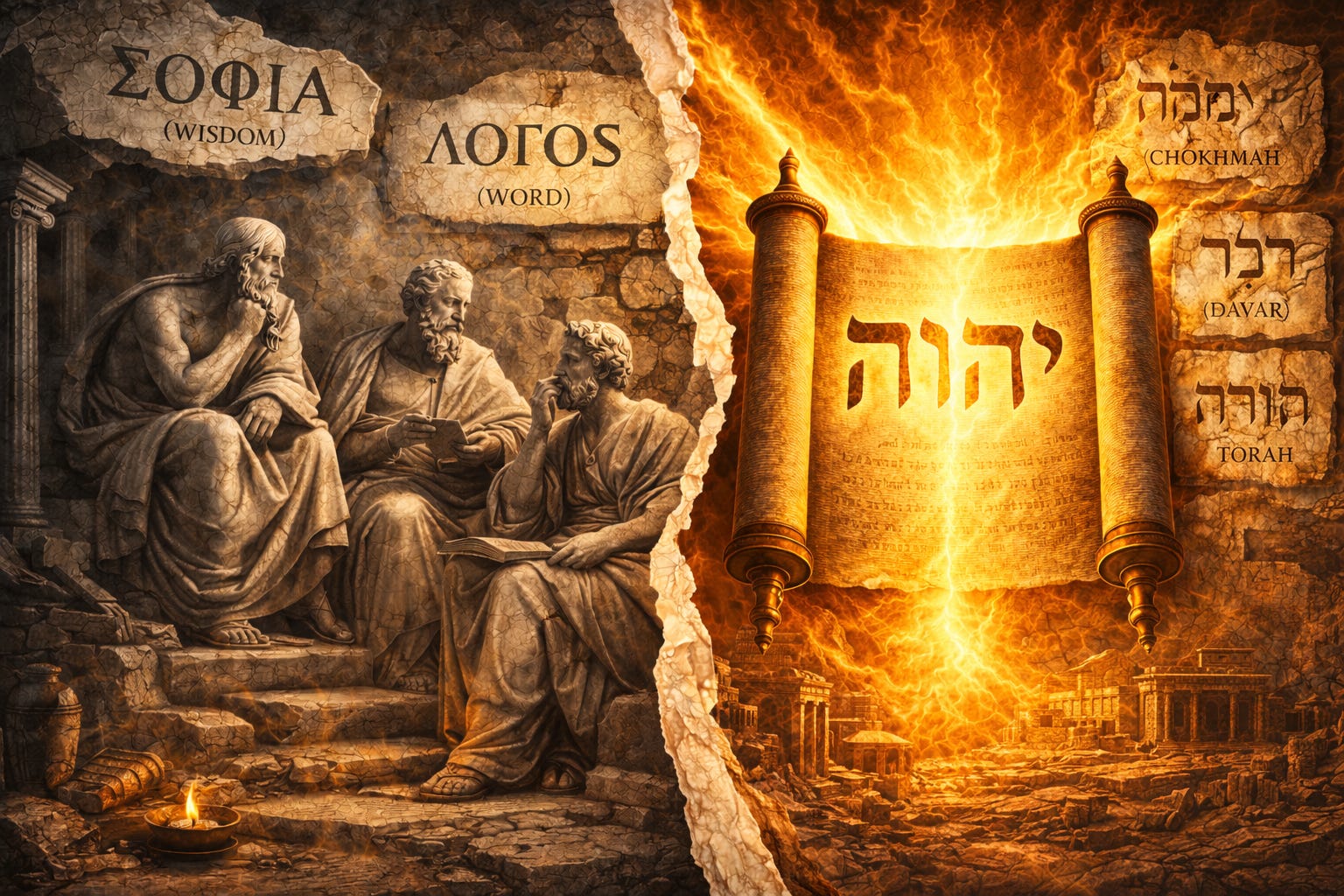
In Part 1, we traced what happened to the names — how YHWH became “the LORD” and Yeshua became “Jesus.” In Part 2, we explored what happened when Hebrew thought was poured into Greek containers — how words like nephesh, emunah, tzedek, and Torah could shift in emphasis through translation.
Now we ask a different question: What happened when the people carrying the faith changed?
The first followers of Yeshua were Jews. They thought in Hebrew categories, even when they spoke Greek. They read the Scriptures as the story of YHWH and Israel. They understood Yeshua as the promised Messiah of Israel, the fulfillment of the covenant, the one in whom the God of Abraham, Isaac, and Jacob was acting to redeem His people.
But within a few generations, the community of Yeshua-followers became increasingly Gentile. And the Gentiles who came to faith brought their own intellectual inheritance. They inherited the Greek Old Testament, Jewish monotheism, and apostolic teaching — but they also brought Greek philosophical habits of thought that would increasingly shape how they explained and defended the faith.
What happened when these worlds met?
The Greek Intellectual World
To understand what may have shifted, we need to understand what educated Gentiles in the 2nd and 3rd centuries brought with them.
The Influence of Plato
By the time of Yeshua, Greek philosophy — particularly the influence of Plato — had shaped the educated world for centuries. Plato’s ideas were not merely academic. They were among the dominant intellectual currents available to educated people in the Greco-Roman world, though the Roman intellectual world also included Stoic, Aristotelian, and other streams.
Some key Platonic ideas that may have shaped how certain Gentile converts heard the faith:
The world of Forms. Plato taught that the physical world is a shadow of a higher, eternal realm — the world of Forms or Ideas. The things we see are imperfect copies of perfect, unchanging originals. True reality is not material but immaterial, not changing but eternal.
The immortal soul. For Plato, the soul (psyche) is immortal and exists before birth. It is trapped in the body (soma), which is inferior and temporary. Death liberates the soul from its bodily prison. In this strand of thought, the goal of philosophy is to prepare the soul for its return to the eternal realm.
The problem of change. Greek philosophy was deeply concerned with the question: What is real? The physical world changes constantly. But Plato argued that true reality must be unchanging. The eternal is more real than the temporal. The immutable is more perfect than the mutable.
The divide between spirit and matter. Flowing from these assumptions, certain streams of Greek thought tended to divide reality into two realms: the spiritual (eternal, perfect, unchanging) and the material (temporal, imperfect, changing). The spiritual was higher; the material was lower.
How This Differs from Hebrew Thought
Hebrew thought, as we explored in Part 2, often tends toward the concrete, active, and unified. The dominant biblical emphasis is not on escape from matter but on covenant life, resurrection, and renewed creation. YHWH creates the physical world and calls it “good.” Human beings are not souls trapped in bodies but living nephesh — embodied, breathing wholes. The hope of Israel is not escape from the body but resurrection — the restoration of the whole person in a renewed creation.
Hebrew thought tends to ask: What has YHWH done? What is He doing? What has He promised to do?
Certain streams of Greek thought tend to ask: What is the unchanging essence behind appearances? What is the eternal nature of things?
These are different emphases. And they can lead to different frameworks for understanding everything — including who Yeshua is.
When Greek Thinkers Met the Jewish Messiah
As the faith spread into the Gentile world, educated converts began to explain and defend the faith using the intellectual tools they knew. This was not necessarily wrong. Paul himself quoted Greek poets (Acts 17:28) and reasoned with philosophers (Acts 17:18-34). The question is what happens over time when one framework increasingly shapes how the faith is articulated.
The Case of the Logos
Consider the opening of John’s Gospel:
“In the beginning was the Word (Logos), and the Word was with God, and the Word was God.” — John 1:1 (TLV)
What did John mean by Logos?
In Hebrew thought, the davar (דָּבָר) — the “word” of YHWH — is not merely speech. It is active, creative power. When YHWH speaks, things happen. “By the word of YHWH the heavens were made” (Psalm 33:6). The davar goes out and accomplishes what YHWH intends (Isaiah 55:11). It is not an abstract concept but a dynamic force.
John’s use of Logos likely resonated with these Jewish scriptural themes. The Logos who “became flesh and dwelt among us” (John 1:14) can be read as the creative, active word of YHWH — now embodied in a human life.
But Greek-speaking readers would also have heard the term against a wider philosophical background.
In Greek philosophy, Logos had a long history. For Heraclitus (6th century BC), Logos was the rational principle governing the universe. For the Stoics, it was the divine reason permeating all things. For Philo of Alexandria — a Jewish philosopher who sought to harmonize Hebrew Scripture with Greek thought — the Logos was an intermediary between the transcendent God and the material world.
When educated Gentile converts read John’s prologue, they may have heard echoes of this philosophical tradition alongside the Jewish scriptural resonances. Over time, the Greek Logos concept could color how John’s words were understood.
This is not to say later interpreters were wrong about everything. But it is worth asking: What might have shifted when the Hebrew davar — active, creative, personal — was increasingly heard through the lens of the Greek Logos — rational, philosophical, abstract?
The Questions Change
As Greek-speaking theologians began to think about Yeshua, they brought questions shaped by their intellectual formation:
What is Yeshua’s essence (ousia)?
How does He relate to the Father in terms of being?
Is He of the same substance as the Father, or a different substance?
If God is unchanging, how can the Son be truly God and also have entered time?
These are ontological questions — questions about the nature of being. They are the kinds of questions Greek philosophy was trained to ask.
The Hebrew Scriptures, by contrast, tend to emphasize different questions:
What has YHWH done?
What has He promised?
How should we respond in faithfulness?
What is Yeshua sent to do?
The Scriptures often present Yeshua in vocational and relational terms: He is the Messiah, the Son, the Servant, the Sent One, the image of the invisible God, the one through whom YHWH is reconciling the world to Himself. The emphasis is frequently on mission, relationship, and covenant.
This does not mean the New Testament avoids high claims about Yeshua’s identity — it clearly makes claims about His preexistence, His agency in creation, and His unique divine status. But later theology increasingly formalized these biblical claims using ontological categories that are not the Bible’s own standard vocabulary. When the primary framework shifts, the questions change — and with them, the kinds of answers that seem necessary.
New Vocabulary Emerges
By the late 2nd and early 3rd centuries, Christian writers were developing new vocabulary to describe what they believed. Much of this vocabulary drew on Greek philosophical language.
Tertullian and Trinitas
Tertullian (c. 155–220 AD) was a Latin-speaking theologian in Carthage, North Africa. He is credited with introducing several terms that would become foundational for later Christian theology, including the Latin word Trinitas — “Trinity.”
Tertullian also introduced the formula that God is “one substance (substantia) in three persons (personae).” He used the conceptual language available in his world to articulate what he believed Scripture required — the Father, Son, and Spirit who are distinct yet one.
Was Tertullian wrong to use these categories? That is not the question we are asking. We are simply tracing where the language came from. The word “Trinity” does not appear in Scripture. The formulation emerged from the intersection of biblical testimony and the philosophical vocabulary available to express it.
Origen and the Soul
Origen of Alexandria (c. 185–254 AD) was one of the most influential early Christian thinkers. He sought to articulate the faith in terms educated Greeks would understand.
Origen was deeply influenced by Platonic thought. He taught the pre-existence of souls — that human souls existed before birth and descended into bodies. He understood salvation partly as the soul’s ascent back to God. Some of his ideas were later rejected by church councils. His influence on how many Christians thought about the soul, the spiritual life, and biblical interpretation was significant — though later orthodox theology did not simply adopt Origen wholesale. He was hugely influential, but also contested.
Notice what may be happening: Hebrew emphases (resurrection of the body, the whole person before YHWH) could be reshaped by Greek emphases (the immortal soul, the body as inferior, salvation as escape from matter) — though the influence was complex and not a simple replacement.
The Language of Ousia and Hypostasis
By the 3rd century, theologians were debating the relationship between the Father and the Son using Greek philosophical terms:
Ousia (οὐσία) — essence, substance, being
Hypostasis (ὑπόστασις) — underlying reality, individual existence
Homoousios (ὁμοούσιος) — “of the same substance”
These terms would become central to the great councils of the 4th century, which we will examine in Part 4. But they did not come from Scripture. They came from Greek philosophical discourse.
Again, we are not here to declare these formulations right or wrong. We are asking: What happens when you take a faith born in Hebrew categories and increasingly express it using Greek philosophical vocabulary? Can the container shape how the content is heard?
What Might Have Shifted
If the Hebrew emphasis was often vocational — What is Yeshua sent to do? — later Greek-influenced theology increasingly emphasized the ontological — What is Yeshua’s essential nature?
If the Hebrew hope was resurrection — the restoration of the whole person in a renewed creation — certain Greek influences tilted toward immortality of the soul — escape from the body into the spiritual realm.
If the Hebrew understanding of the Logos was dynamic — the powerful, creative word of YHWH that accomplishes His purposes — Greek philosophical backgrounds could hear something more abstract — the rational principle underlying reality.
If Hebrew thought tended to hold body and spirit together as an integrated whole, certain streams of Greek thought tended to divide them — privileging the spiritual over the material.
None of this means the Greek-speaking theologians were insincere or ignorant. Many were brilliant, devout, and seeking to be faithful to what they had received. But they were working in a different intellectual world, asking different questions, using different categories.
And over time, those categories became one of the main vocabularies through which many Christians articulated the faith — so standard that many Christians today assume these are simply “what the Bible teaches,” without realizing that the framework came from elsewhere.
The Question This Raises
We are not here to tell you what to believe about the Trinity, the nature of Yeshua, or the immortality of the soul. These are important questions, and serious believers have wrestled with them for centuries.
But we are asking: Do you know where the categories came from?
When you hear “one substance in three persons,” do you realize that language came from 2nd- and 3rd-century theologians using Greek philosophical vocabulary — not from the Hebrew Scriptures directly?
When you hear that your soul is immortal and will go to heaven when you die, do you realize that framework reflects substantial Greek philosophical influence alongside biblical and Jewish strands of thought? The Hebrew prophets spoke of resurrection, not primarily of disembodied afterlife.
When you hear debates about Yeshua’s “divine nature” and “human nature,” do you realize those are Greek ontological categories — and that the Hebrew Scriptures often present Him in vocational terms, as the one sent by the Father to accomplish redemption?
This does not mean the later formulations are necessarily false. It means they are formulations — human attempts to express in one conceptual framework what was originally revealed in another.
And if the framework has shaped what we hear, it is worth asking: What might we hear if we went back to the Hebrew roots?
Questions to Sit With
Have you ever considered the difference between Hebrew questions (”What has YHWH done? What is Yeshua sent to do?”) and Greek questions (”What is Yeshua’s essence? What is His nature?”)? Which questions feel more familiar to you?
When you think about salvation, do you picture your soul going to heaven — or resurrection in a renewed creation? Where did your picture come from?
When you read “the Word became flesh,” do you hear a philosophical concept becoming human — or the active, creative davar of YHWH embodied in a person? Could it be both?
Does it surprise you that terms like “Trinity,” “substance,” and “persons” came from Greek philosophical vocabulary rather than Scripture directly? How does that affect how you hold those formulations?
What might it mean to ask Hebrew questions about Yeshua — to focus on His mission, His relationship to the Father, and what He was sent to accomplish — rather than primarily on His metaphysical essence?
An Invitation
In Part 4, we will trace what happened when the Empire got involved — when the debates of theologians became the decrees of councils backed by imperial power. We will look at Nicaea, Constantinople, and the creeds that emerged.
But before we go there, we wanted to pause here — at the moment when the questions changed. When Greek thinkers encountered the Jewish Messiah and began to explain Him using their own intellectual categories.
This is not a story of villains. It is a story of faithful people doing their best to articulate what they believed. But it is also a story of containers shaping content — of one way of thinking gradually overlaying another.
And if we can see that process, we can ask: What was there before? What might we recover?
The Hebrew Scriptures are still available. The questions they ask are still open. And the Ruach who inspired them is still speaking.
Next: Part 4 — Where Did the Creeds Come From?
Sources Referenced: