

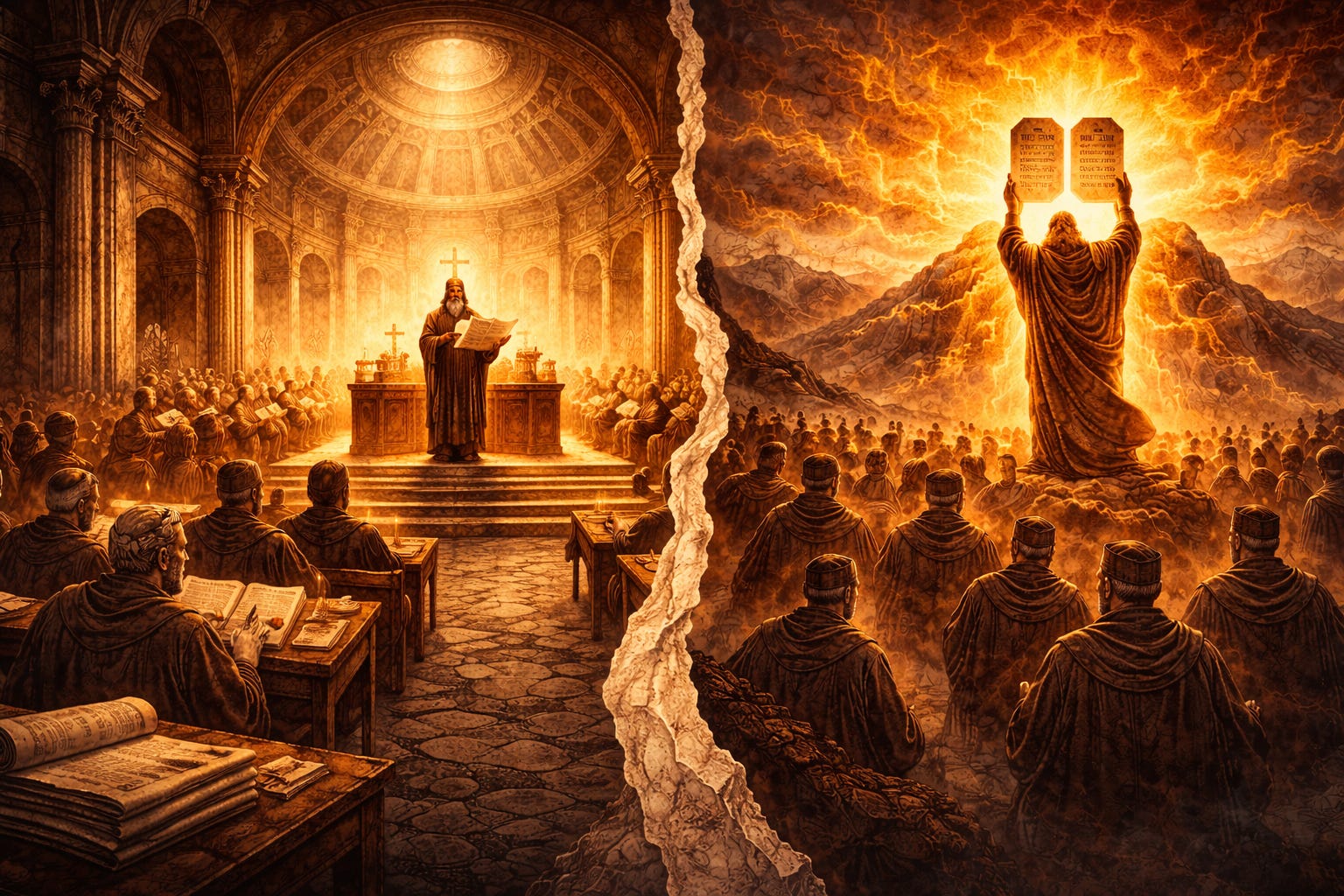
The Setting: A Divided Church
By the early 4th century, Christianity had survived waves of persecution. But it was also deeply divided.
The most pressing controversy concerned the relationship between the Father and the Son. Was the Son fully divine, equal to the Father? Or was He a created being — exalted above all creation, but not truly God in the same sense?
A presbyter named Arius in Alexandria taught that the Son was the first and greatest of God’s creations — but still created. “There was a time when He was not,” Arius reportedly said. The Son was divine in some sense, but not eternal, not of the same essence as the Father.
His bishop, Alexander (and later Alexander’s successor, Athanasius), argued the opposite: the Son is eternal, uncreated, fully God — of the same essence (homoousios) as the Father. To say otherwise, they argued, was to undermine the faith itself.
This was not merely an academic debate. It touched on salvation, worship, and the identity of the one Christians called Lord. And it was tearing communities apart.
Constantine Steps In
In 312 AD, Constantine won the Battle of Milvian Bridge and attributed his victory to the Christian God. The following year, in 313 AD, he and his co-emperor Licinius issued the Edict of Milan, which granted legal toleration to Christians throughout the Empire.
Christianity was no longer illegal. But Constantine wanted more than toleration. He wanted unity.
A divided church did not serve an emperor seeking to unify a fractured empire. When the Arian controversy threatened to split Christianity, Constantine took an unprecedented step: he convened a council of bishops to settle the matter.
In 325 AD, roughly 300 bishops gathered at Nicaea (in modern-day Turkey) at the emperor’s invitation — and expense. This was the first “ecumenical” council: a gathering intended to represent the whole church.
Constantine himself was not a theologian. By some accounts, he was not even baptized until near his death. But he presided over the opening of the council, urged the bishops toward consensus, and made clear that he expected a resolution.
A Detail Worth Noticing
Here is something worth pausing on: While Constantine convened Christian councils, he also retained the title Pontifex Maximus — the chief priest of Roman state religion.
This title had existed since before the Republic. Julius Caesar held it. Augustus held it. Every emperor held it. It was the position responsible for overseeing Roman religious practice — the temples, the rituals, the priests.
Constantine kept this title even as he presided over Nicaea. The man shaping how Christian orthodoxy was defined was simultaneously the chief priest of Roman paganism — at least in title.
The title Pontifex Maximus was not relinquished by emperors until Gratian in 382 AD — a year after the Council of Constantinople. And even then, the language did not disappear from Christian usage. The word pontifex later became associated with the bishop of Rome, and pontifex maximus has often appeared in papal inscriptions and later usage, though it is not part of the standard official papal title list today.
We are not here to declare what this means. But we notice a pattern: the language persisted. The institutional framework remained. The occupant changed.
When an empire absorbs a faith, what else transfers along with it? What structures, what titles, what ways of organizing religious life? These are questions we will return to in Part 5. For now, we simply notice: the boundaries between Roman imperial religion and the faith of the shaliach movement were becoming harder to trace.
The Council of Nicaea (325 AD)
The bishops at Nicaea debated the central question: How should the church describe the relationship between the Father and the Son?
The Arian position — that the Son was created, not eternal — was rejected by the majority. But what language should replace it?
The council settled on a term that would shape Christian theology for centuries: homoousios (ὁμοούσιος) — “of the same substance” or “of the same essence.”
The Son, the creed declared, is “of one substance with the Father” — not created, not lesser, but sharing the same divine essence.
This was a Greek philosophical term. It did not come from Scripture. The word homoousios appears nowhere in the Bible. But the bishops believed it captured what Scripture required: that the Son is fully divine, not a creature.
The resulting statement — the Nicene Creed — became the standard of orthodoxy:
We believe in one God, the Father Almighty, maker of all things visible and invisible. And in one Lord Jesus Christ, the Son of God, begotten from the Father, only-begotten, that is, from the substance of the Father, God from God, Light from Light, true God from true God, begotten not made, of one substance (homoousios) with the Father...
Arius and some who rejected the Nicene settlement were condemned and, in some cases, exiled under imperial authority. Imperial power now backed theological conclusions.
What Else Happened at Nicaea — and What Didn’t
The creed was not the only business at Nicaea. The council also addressed:
The date of Easter. There was significant disagreement about when to celebrate the resurrection. Some communities — particularly in Asia Minor — celebrated on the 14th of Nisan, the same day as Passover, regardless of what day of the week it fell on. They were called Quartodecimans (from the Latin for “fourteenth”). Others insisted Easter must fall on a Sunday. Nicaea ruled against the Quartodeciman practice and established that Easter would be calculated independently from the Jewish calendar. We will explore this further in Part 7, when we ask what happened to the appointed times.
Church discipline canons. The council issued twenty canons addressing matters of church order — how bishops should be ordained, how the lapsed (those who had denied the faith under persecution) should be restored, how clergy should conduct themselves. These were organizational decisions, not doctrinal ones.
The Meletian schism. A dispute in Egypt about how to treat those who had compromised during persecution.
But here is something worth clarifying, because it is often misunderstood:
Nicaea did not decide the biblical canon.
It is sometimes claimed that the Council of Nicaea determined which books belong in the Bible — that the bishops voted on what was Scripture and what was not, excluding certain gospels and texts. This is not accurate.
The question of which books were authoritative developed gradually over centuries. Various lists circulated in different communities. The councils that addressed the canon came later — the Council of Laodicea (c. 363 AD), the Council of Rome (382 AD), the Councils of Hippo (393 AD) and Carthage (397 AD, 419 AD). Even then, the Eastern and Western churches maintained slightly different lists for centuries.
The books sometimes called the Apocrypha — Tobit, Judith, Wisdom, Sirach, 1-2 Maccabees, Baruch, and others — were part of the Septuagint, the Greek Old Testament that the early church used. They remained in Christian Bibles for over a thousand years. It was only at the Reformation that Protestant Bibles removed them.
We raise this not to resolve the question of which books belong in Scripture, but to note that the question exists — and that the answer involved human decisions, councils, and criteria that developed over time. Who decided what was in and what was out? On what basis? What might we learn from the texts that were excluded — or from those that were included in some traditions but not others?
These are questions worth investigating. For now, we simply note: Nicaea did not settle them.
The Controversy Continues
If the Council of Nicaea had settled even the matters it did address, Part 4 would end here. But it didn’t.
In the decades following Nicaea, the controversy continued. Emperors shifted their support between Nicene and Arian (or semi-Arian) positions depending on their own convictions and political calculations. Bishops were exiled, recalled, exiled again. Athanasius, the great defender of Nicaea, was exiled five times.
The term homoousios itself was controversial. Some worried it sounded too close to modalism — the idea that Father, Son, and Spirit are just different modes of one person. Others proposed homoiousios (”of similar substance”) as a compromise. The difference of a single letter — an iota — carried enormous theological weight.
For much of the 4th century, it was not clear which position would prevail. The outcome depended not only on theological argument but on which emperor held power and which bishops had his ear.
Theodosius and the Council of Constantinople (381 AD)
The turning point came with Emperor Theodosius I.
In 380 AD, Theodosius issued the Edict of Thessalonica, which declared Nicene Christianity the official religion of the Roman Empire. This was not merely toleration or even imperial favor. This was establishment. For the first time, one form of Christianity was legally required, and all others were prohibited.
The edict declared that all peoples under Roman rule should follow the faith “which the divine Apostle Peter transmitted to the Romans” — specifically, the faith that affirms the Trinity as defined by the bishops of Rome and Alexandria. Those who did not hold this faith would “suffer in the first place the chastisement of the divine condemnation, and in the second the punishment which our authority, in accordance with the will of Heaven, shall decide to inflict.”
Under Theodosius, doctrinal dissent now carried imperial legal and political penalties.
In 381 AD, Theodosius convened the Council of Constantinople. This council reaffirmed and expanded the Nicene Creed, adding language about the Holy Spirit:
And in the Holy Spirit, the Lord, the giver of life, who proceeds from the Father, who with the Father and the Son is worshiped and glorified...
The creed that emerged from Constantinople — often called the Niceno-Constantinopolitan Creed — is essentially the creed still recited in many churches today.
What Happened Here?
We are not here to declare whether the creeds are true or false. Serious believers have affirmed them for seventeen centuries. Others have questioned whether non-biblical language should carry such weight.
But we are asking: Do you know what happened?
Greek philosophical vocabulary became a norm-setting language. The term homoousios — a word that does not appear in Scripture — became the test of orthodoxy. To deny it was to be a heretic. Greek philosophical vocabulary became a norm-setting language for defining orthodoxy in the imperial church.
The Empire got involved. Constantine convened Nicaea not primarily as a theologian but as an emperor seeking unity. Theodosius went further, making Nicene Christianity the only legal religion. What had been a theological debate became a matter of imperial law.
Dissent carried consequences. Before Constantine, Christians were persecuted by Rome. After Theodosius, Christians who held the “wrong” theology could face penalties from other Christians backed by Roman power. The empire that had once fed believers to lions now enforced which beliefs about God were permitted.
The process was not smooth. The creeds did not emerge from a single, unified council speaking with one voice. They emerged from decades of controversy, shifting imperial politics, exiles and counter-exiles, and the eventual triumph of one position backed by imperial power.
The Question This Raises
We are not asking you to reject the creeds. We are asking you to understand how they came to be.
The Nicene Creed is not Scripture. It is a human formulation — produced by bishops, using Greek philosophical vocabulary, under imperial sponsorship, enforced by imperial law.
This does not make it false. But it does make it something other than “what the Bible plainly teaches.” It is an interpretation, expressed in one particular conceptual framework, shaped by the controversies of its time, and established through a process that involved emperors as much as theologians.
For most of Christian history, questioning the creeds was not permitted. To doubt was to risk exile, exclusion, or worse. The invitation to “come and see” had become “believe this or else.”
We are not asking you to reject what the creeds affirm. We are asking: What does it mean that this is how orthodoxy was established? And does the process itself raise questions worth sitting with?
Questions to Sit With
Did you know that the word homoousios (”of the same substance”) does not appear in Scripture? How does that affect how you hold the Nicene Creed?
Does it change anything for you to know that Constantine — not a theologian, possibly not even baptized — convened the council that produced the creed?
What do you make of the fact that Theodosius made Nicene Christianity the only legal religion, with penalties for those who disagreed?
The Arian controversy was not settled in a single council but through decades of debate, exile, and shifting imperial politics. Does that surprise you?
Yeshua invited people to “come and see.” The creeds, as established, came with the force of imperial law. What, if anything, is lost when faith moves from invitation to enforcement?
An Invitation
In Part 5, we will ask: When did the Empire get involved — and what changed when it did? We will trace the broader pattern of the 4th century: the shift from persecuted movement to state religion, from scattered communities to imperial institution.
But before we go there, we wanted to pause here — at the moment when the creeds were formed. Not to tear them down, but to understand them. To see that they are human documents, produced in a particular time, shaped by particular controversies, established through a particular process.
The creeds may contain truth. But they are not Scripture. They are formulations. And understanding how they came to be is part of understanding what was lost — and what might still be recovered.
Next: Part 5 — When Did the Empire Get Involved?
Sources Referenced: