

In Part 4, we traced how the creeds emerged — how Greek philosophical vocabulary became the test of orthodoxy, how Constantine convened Nicaea as emperor, and how Theodosius made Nicene Christianity the only legal religion of the Empire.
Now we step back and ask a broader question: What changed when the shaliach movement went from persecuted sect to state religion?
The Movement Before Constantine
For three centuries, the movement Yeshua launched operated without consistent legal standing or imperial favor. Gatherings happened primarily in homes and informal spaces. Leadership was relational and functional, with emerging structures but not yet centralized in the way it would later become. The community was defined by covenant, not geography.
But what do we call this movement?
The word “Christian” appears only three times in the New Testament — and never clearly as a self-designation by believers. It was likely an outsider label, first used in Antioch (Acts 11:26). The earliest followers referred to their way of life as “the Way” (Acts 9:2, 19:9, 19:23, 24:14, 24:22). But the concept that shaped their identity runs deeper than any single term.
The Shaliach Pattern
The Hebrew concept of shaliach (שָׁלִיחַ) means “sent one” — a representative who carries the authority of the sender. While the Greek word apostolos is not a direct translation, it closely overlaps with this idea, and is the term used throughout the New Testament.
In the Torah, Moses functions in this pattern — sent by YHWH to Pharaoh with a message and a mission (Exodus 3:10-15). The prophets also embody this sending: “Whom shall I send? And who will go for us?” (Isaiah 6:8, TLV). Later Jewish tradition would summarize this principle: “A man’s shaliach is as himself.”
Yeshua explicitly framed His own mission in these terms: “I have come down from heaven, not to do My own will but the will of the One who sent Me” (John 6:38, TLV). And He extended the same commission to His followers: “As the Father has sent Me, so I am sending you” (John 20:21, TLV).
The movement was not centered on buildings or formalized doctrinal systems as it would later become. It was defined by being sent — a pattern that runs from Moses through the prophets through Yeshua through the ekklesia.
For three centuries, this sent identity shaped everything.
Then the empire got involved.
Constantine’s 321 AD Sunday Decree
On March 7, 321 AD, Emperor Constantine issued a decree that would reshape the weekly rhythm of an empire:
“On the venerable day of the Sun let the magistrates and people residing in cities rest, and let all workshops be closed.”
Notice what the decree does not say. It does not mention the resurrection. It does not reference the Lord’s Day. It does not appeal to Scripture. The language is “venerable day of the Sun” — dies Solis — the day already dedicated to Sol Invictus, the Unconquered Sun, the official cult of the Roman state.
Constantine’s relationship with Sol Invictus is well documented. Before his reported conversion, he minted coins featuring Sol Invictus and dedicated monuments to the sun god. After his alignment with Christianity, the solar imagery didn’t immediately disappear. The famous Chi-Rho symbol appeared alongside solar iconography. This reflects a transitional period where imperial symbolism had not yet fully disentangled from earlier religious forms.
This matters because the Sunday decree wasn’t a theological decision made by the ekklesia. It was an imperial calendar decision made by a Roman emperor using religious language already embedded in Roman civic life. Christians in various communities were already gathering on Sunday before Constantine — this was not a new practice. But imperial recognition reinforced and accelerated a shift already underway, giving it the force of law and the weight of state sponsorship.
We explored in Part 4 how the pattern of distancing from Jewish practice was already underway — the Council of Nicaea ruled against the Quartodeciman practice and moved toward calculating Easter independently from the Jewish calendar. Constantine’s Sunday decree did not initiate these shifts, but it accelerated and standardized patterns that were already emerging. The calendar changes that would eventually marginalize the Moedim gained momentum here — not from Scripture alone, but from empire.
From Scattered Communities to Imperial Institution
Before Constantine, the ekklesia had no legal standing. Property ownership was precarious. Gatherings could be raided. Leaders could be arrested, exiled, or executed. The movement survived not because of institutional strength but because of relational networks, shared conviction, and the willingness to suffer.
After the Edict of Milan in 313 AD, everything changed.
Christianity became legal. Then it became favored. Constantine returned confiscated property, funded church building projects, granted clergy exemption from certain taxes and civic duties, and began consulting bishops on matters of imperial policy. By the end of the fourth century, bishops sat in positions of civic authority. Church courts had legal jurisdiction. The ekklesia owned land, buildings, and wealth.
This was not an uncomplicated gift.
Imperial favor came with imperial expectations. Constantine convened the Council of Nicaea in 325 AD — not as a bishop, but as emperor. He presided over theological disputes not because he had spiritual authority but because unity served political stability. The church that had once existed in tension with empire now depended on empire for its institutional life.
The scattered, relational communities of the first three centuries began consolidating into something that looked more like a Roman institution. Bishops became administrators. Regions became dioceses — a term borrowed directly from Roman imperial governance. The ekklesia didn’t just exist within the empire. It began to mirror the empire’s organizational logic.
The Aesthetics of Empire
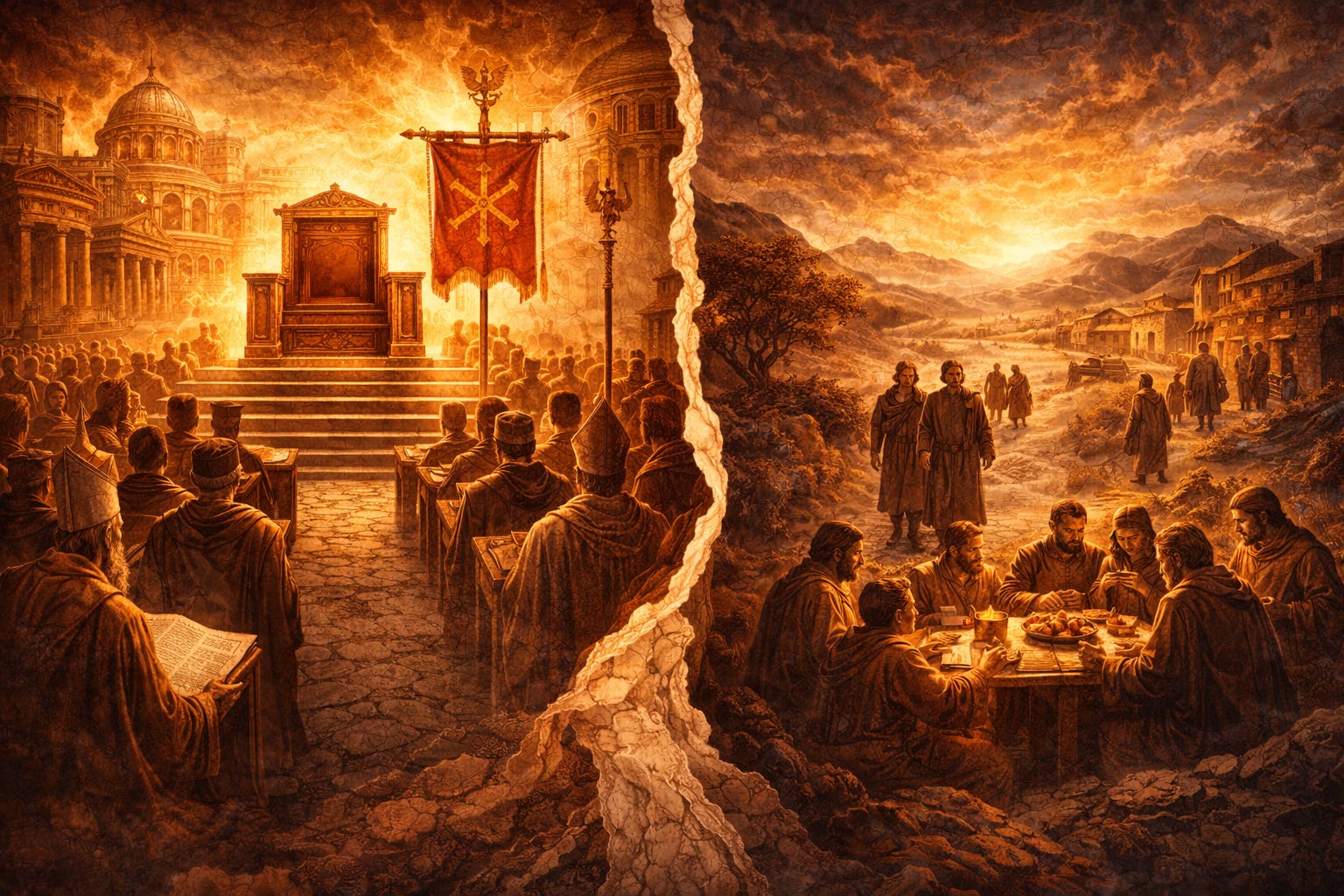
Walk into a medieval cathedral — or many modern churches — and you encounter a visual grammar that would have been foreign to the first-century ekklesia.
Elevated platforms. Robed clergy. Processions with incense. Choirs in designated spaces. The congregation facing forward, observing. This is not the layout of a Passover meal or a home gathering. This is the layout of a Roman basilica — the public building used for legal proceedings and imperial audiences.
When Constantine began funding church construction, the basilica became the default template. It made practical sense: these were large public buildings already associated with civic authority. But architecture shapes practice. The shift from a shared meal around a table to an audience observing a performance at the front changed what participation meant.
The vestments worn by clergy also have imperial roots. The alb, the stole, the chasuble — these evolved from Roman formal dress, not from the priesthood of ancient Israel. The visual message was clear: this is an institution of dignity and authority, recognizable within the Roman framework.
None of this happened because someone sat down with Scripture and concluded that Roman aesthetics were biblically required. It happened because the ekklesia was now operating within empire, funded by empire, and increasingly shaped by the cultural grammar of empire.
The gathering began to look like Rome.
The Great Inversion
Here is the shift that matters most.
Yeshua’s commission was directional: “Go — as the Father has sent Me, so I am sending you” (John 20:21). The shaliach pattern is outward. You are sent into the world carrying the authority and mission of the One who sends.
The imperial model shifted the emphasis: “Come — worship here.”
Once the ekklesia had buildings, those buildings became the center of religious life. Once clergy had civic authority, the institution needed people to come to it. The parish system — organizing believers by geography rather than covenant relationship — emerged as the default structure. You belonged to the church in your district whether you had chosen it or not.
The balance increasingly shifted from a primarily sent movement to one where gathering became central and eventually dominant.
This is not to say that gathering is wrong. The New Testament clearly describes believers assembling together, and early Christians did so from the beginning. But there is a difference between a sent community that gathers for equipping and encouragement before scattering again — and an institution that defines faithfulness primarily as attendance.
The emphasis shifted from “go into all the world” to “come to the building on Sunday.” The measure of faithfulness increasingly became participation in religious services rather than obedience in daily life. The shaliach identity — defined by being sent — was gradually overshadowed by a membership identity defined by showing up.
This shift didn’t happen because someone argued for it theologically. It happened because institutional logic rewards gathering, counting, and consolidating. Once the ekklesia became a legal institution with property and budget, it needed attendance. The structure itself shaped the emphasis.
The Principality Playbook
[Link to Principality Playbook]
We’ve explored elsewhere how principalities operate — not as cartoonish demons whispering in ears, but as systemic spiritual architectures embedded in institutions. The pattern is consistent: structures outlast individuals. Remove a corrupt leader, and the structure that produced the corruption remains. Replace personnel, and the institution continues functioning according to its embedded logic.
This is exactly what happened in the fourth century.
Constantine died in 337 AD. His personal faith, whatever it actually was, went with him. But the structures he built — the legal frameworks, the basilicas, the relationship between church and state, the calendar, the aesthetic grammar — all of it persisted. His successors inherited an institutional Christianity that no longer required Constantine’s personal involvement to continue operating.
This is why individual renewal rarely reverses systemic drift.
You can have sincere believers within the structure. You can have reformers who challenge specific abuses. But if the structure itself embeds assumptions that pull against the shaliach pattern — if the institution rewards “come” more than “go” — then reform efforts will be absorbed, domesticated, or eventually expelled. The architecture remains.
The Reformation, twelve centuries later, challenged many doctrines but largely retained the inherited institutional framework — including the calendar, the parish model, and the centrality of gathered worship. Luther and Calvin reformed within the structure Constantine built. They did not return to the shaliach pattern.
This is not an accusation. It’s an observation about how institutional architecture works. The principality playbook doesn’t require villains. It only requires structures that persist — and people who inherit those structures without examining their origins.
What Happened Here?
We are not here to declare that Constantine was a villain or that the fourth-century church made only wrong decisions. Real believers faced real dilemmas. Imperial favor solved real problems — persecution, instability, lack of resources.
But we are asking: Do you know what changed?
The calendar was standardized. Constantine’s Sunday decree established the “venerable day of the Sun” as the weekly rhythm of empire. This reinforced and accelerated patterns already emerging in many Christian communities, giving them imperial weight.
The structure shifted. The ekklesia went from scattered, relational communities to a centralized institution with property, legal standing, and civic authority. Bishops became imperial officials. The organizational logic of Rome became the organizational logic of the church.
The aesthetics shifted. Basilicas replaced home gatherings. Roman vestments replaced simple clothing. The visual grammar of empire became the visual grammar of worship.
The emphasis shifted. The shaliach commission — “go, you are sent” — was increasingly overshadowed by “come, worship here.” The parish system organized believers by geography rather than covenant. Faithfulness was increasingly measured by attendance.
The architecture persisted. Constantine died, but the structures he built did not. The Reformation challenged doctrines but largely kept the inherited institutional framework. We still inhabit that architecture today.
The Question This Raises
We are not asking you to reject everything that happened in the fourth century. We are asking you to see it clearly.
The movement Yeshua launched was defined by being sent. The institution that emerged from the fourth century increasingly emphasized gathering. These are not the same thing.
The shaliach pattern asks: Where are you being sent? What mission have you been given? How do you carry the authority of the One who sends you into the world?
The institutional pattern asks: Are you attending? Are you participating in the services? Are you a member in good standing?
Both questions have a place. But when the second overshadows the first — when membership substitutes for mission — something essential has been lost.
We are not asking you to leave your church or reject your tradition. We are asking: What would it look like to recover the shaliach identity? To be defined not primarily by where you gather but by where you are sent?
Questions to Sit With
Did you know that Constantine’s Sunday decree used the language “venerable day of the Sun” — not the resurrection or the Lord’s Day? Does that change how you think about the origins of Sunday as the imperial rest day?
The ekklesia went from scattered home gatherings to an institution with basilicas, legal standing, and civic authority — all within a few decades. What was gained in that transition? What was lost?
The shaliach pattern says “go — you are sent.” The institutional pattern says “come — worship here.” Which one shapes your understanding of what faithfulness looks like?
The Reformation challenged many doctrines but largely retained the inherited institutional framework — the calendar, the building-centered model, the parish structure. Does that surprise you?
If principalities operate through institutional architecture that outlasts individuals, what does that suggest about why reform efforts often don’t reverse systemic drift?
An Invitation
By 380 AD, Emperor Theodosius issued the Edict of Thessalonica, making Nicene Christianity the official state religion of the Roman Empire. The transformation was complete. The relationship between empire and ekklesia had fundamentally changed — with imperial structures increasingly shaping how the church was organized and expressed.
In Part 6, we will ask what comes next: the theological consolidation that locked these structural changes into doctrine — and made them appear not as historical contingencies but as unchangeable truth.
But before we go there, we pause here — at the moment when empire and ekklesia merged. Not to condemn everyone involved, but to understand what happened. To see that the patterns we’ve inherited are not simply “how it’s always been.” They have origins. They have histories. And understanding those histories is the first step toward asking what might be recovered.
Next: Part 6 — How Did Structure Become Doctrine?
Sources Referenced: