

In Part 6, we traced how the fourth-century church consolidated structure into doctrine — how creeds were reinforced by imperial authority, how canon lists were stabilized by councils, and how historical decisions became “how it’s always been.”
By the sixteenth century, that architecture had been inherited for over a thousand years. The medieval church had built layer upon layer on top of the Constantinian foundation — papacy, sacramental system, indulgences, purgatory, a Latin Bible most people couldn’t read, and a priestly class that controlled access to God.
Then came the Reformation.
Luther, Calvin, Zwingli, and others challenged real abuses. They recovered real truths. They broke real chains. But they did so from inside the house Constantine built. They rearranged the furniture. They threw out some of it. But they never questioned the foundation.
This is the story of what the Reformation fixed, what it kept, and what questions were never on the table.
The Crisis That Sparked Reform
By the early sixteenth century, the Western church had accumulated practices that were difficult to defend from Scripture.
Indulgences had become a funding mechanism. The idea that you could purchase reduction of time in purgatory — for yourself or deceased relatives — had grown into a commercial enterprise. Johann Tetzel’s famous sales pitch reportedly included the jingle: “As soon as the coin in the coffer rings, the soul from purgatory springs.”
Papal authority had expanded far beyond anything the early church would have recognized. The Bishop of Rome claimed supreme authority over all Christians, the power to release souls from purgatory, and infallibility in matters of faith and morals.
The sacramental system had placed priests as essential mediators between believers and God. You could not receive grace without the church’s authorized channels. The Mass was performed in Latin. The cup was withheld from laypeople. The Bible was inaccessible to most.
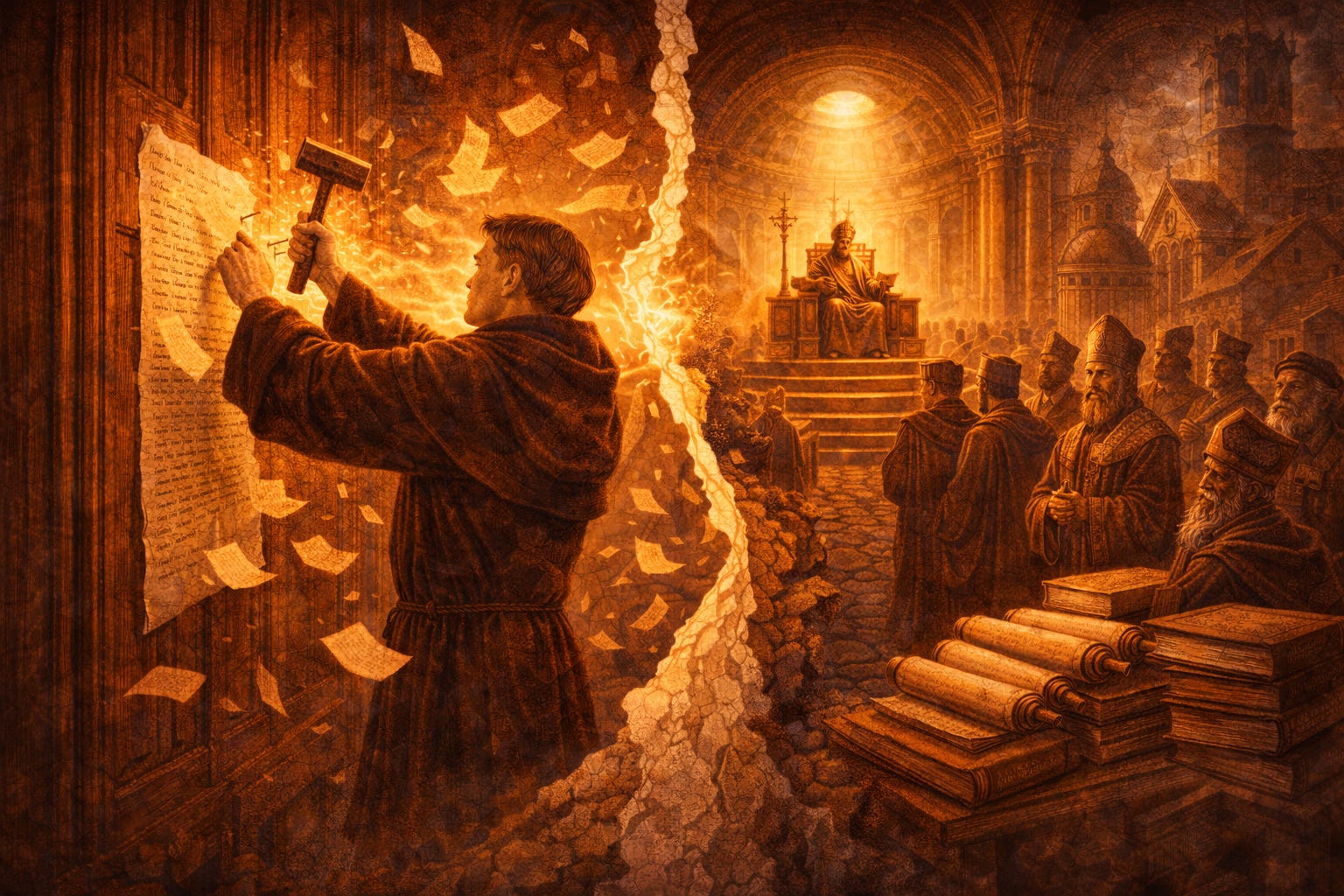
On October 31, 1517, Martin Luther posted his 95 Theses on the door of the Castle Church in Wittenberg. His initial target was indulgences — but the challenge quickly expanded. If indulgences couldn’t be defended from Scripture, what else couldn’t be?
Luther’s breakthrough was justification by faith alone — the recovery of Paul’s teaching that we are made right with God through trust in Messiah, not through accumulated works or purchased merit. This single insight cracked the foundation of the medieval system. If salvation comes by faith, the entire apparatus of merit, indulgence, and priestly mediation becomes unnecessary.
The grievances were real. The abuses were real. The recovery was real.
But it was a recovery within limits.
What the Reformation Changed
The Reformers dismantled significant portions of the medieval system. This was genuine and consequential work.
Papal supremacy was rejected. Luther, Calvin, and other Reformers denied that the Bishop of Rome had universal authority over the church. They argued that no single human institution could claim to be the sole mediator of God’s grace.
Scripture was elevated over tradition. The principle of sola scriptura — Scripture alone as the final authority — challenged the Catholic claim that church tradition carried equal weight with the Bible. This opened the door to testing inherited practices against the text.
The priesthood of all believers was recovered. The Reformers taught that every believer has direct access to God through Yeshua — no human priest required as mediator. This dismantled the clerical monopoly on spiritual authority.
The Bible was translated into vernacular languages. Luther’s German Bible (1534) and Tyndale’s English translation deeply shaped later English Bibles, including the King James Version of 1611. For the first time in centuries, laypeople could read the text for themselves.
Indulgences, purgatory, and several sacraments were rejected. The Reformers reduced the seven Catholic sacraments to two (baptism and communion) and denied that any human institution could sell or dispense grace.
The deuterocanonical books were set apart or removed. Luther questioned the Apocrypha and set those books apart as useful for reading but not for establishing doctrine. Later Protestant Bibles removed them entirely, aligning the Old Testament with the Hebrew canon recognized in rabbinic Judaism, in contrast to the broader canon long used in much of the church.
These changes were substantial. They broke real chains and recovered real truths. Millions of people gained access to Scripture and to a gospel of grace rather than purchased merit.
But the Reformation also kept more than it questioned.
What the Reformation Kept
Here is what the magisterial Reformers — Luther, Calvin, Zwingli, and their successors — did not challenge.
The Sunday calendar. The magisterial Reformers largely inherited and retained the long-established Christian practice of Sunday worship rather than restoring seventh-day Sabbath observance. The seventh-day Sabbath was not restored in the magisterial Reformation. Some later Protestant groups would revisit the question, but the main Reformers did not.
The building-centered, attendance-based model. The Reformation kept the assumption that faithfulness meant coming to the church building for services. The emphasis remained on gathering, not on being sent. The shaliach pattern — “go, you are sent” — was not recovered.
The parish and congregational structure. Believers were still organized by geography rather than covenant relationship. You belonged to the church in your territory. The relational, network-based model of the first three centuries was not revisited.
Infant baptism. Luther, Calvin, and Zwingli all retained the practice of baptizing infants, though the Reformers’ defense of the practice depended on theological argument rather than an explicit New Testament command. They developed justifications — covenant inclusion, replacement of circumcision — but the practice itself was inherited from the post-apostolic church.
Creedal orthodoxy. The Reformers assumed the Nicene and Chalcedonian creeds as their baseline. They did not question whether Greek philosophical categories were the right framework for articulating the faith. The fourth-century formulations were treated as settled.
Church-state entanglement. The Reformation did not separate church from state. Instead, it produced a new form of entanglement: cuius regio, eius religio — “whose realm, his religion.” The Peace of Augsburg (1555) established that the ruler of a territory determined its official religion. Lutheran princes enforced Lutheranism. Reformed territories enforced Calvinism. The Constantinian model of state-sponsored Christianity continued, just with different sponsors.
The inherited Christian liturgical calendar. The liturgical year, including Christmas and Easter, was retained in substantial form by the magisterial Reformers, though with differing degrees of enthusiasm. The biblical Moedim — Passover, Shavuot, Sukkot — were not considered for recovery.
The inherited theological vocabulary. The Reformers operated within the theological categories inherited from the councils — substance, essence, persons, nature. They did not return to the Hebraic framework of covenant, shaliach, and Torah.
What Was Never Asked
Beyond what was kept, there were questions the Reformers never raised.
Was the fourth-century institutional model itself the problem? The Reformers challenged doctrines that had accumulated on top of the Constantinian foundation. They did not question whether the foundation itself — the merger of church and empire, the shift from movement to institution — was where things went wrong.
Should the shaliach pattern be recovered? The emphasis on “go, you are sent” versus “come, worship here” was not part of the Reformation conversation. The building-centered, attendance-measured model of church was assumed.
What about the Hebraic roots? The Reformers returned to Paul — but read him through Augustine and medieval categories. They did not ask what Paul looked like in his original Jewish context. The Torah, the Moedim, the covenant framework of Israel — these were not on the table.
Should the Sabbath be restored? A few later groups — Seventh Day Baptists, Seventh-day Adventists — would raise this question. But the magisterial Reformers did not. Sunday worship was inherited and passed on.
What about the biblical feasts? Passover, Shavuot, Sukkot — the appointed times that Yeshua fulfilled and that Paul continued to observe — were not considered for recovery.
Was the ekklesia meant to be a territorial institution at all? The Reformers reformed the institution. They did not ask whether the ekklesia was supposed to be a voluntary covenant community defined by being sent rather than a territorial institution defined by membership and attendance.
These questions were outside the frame. The Reformers were working within the house Constantine built, repairing and renovating. They were not asking whether a different house had existed before — or whether it might be time to recover the original blueprints.
The Radical Reformation
Not everyone stayed inside the house.
The Anabaptists — a diverse movement emerging alongside the magisterial Reformation — pushed further. They rejected infant baptism, insisting that only believers who could confess faith should be baptized. They rejected the union of church and state, arguing that the ekklesia should be a voluntary community of committed disciples, not a territorial institution enforced by princes. Many embraced pacifism, refusing to take up the sword.
They were persecuted for it — by Catholics and Protestants.
Luther condemned the Anabaptists. Under Zürich’s Protestant regime, Felix Manz was drowned in 1527, a stark sign that magisterial reformers also used coercion against Anabaptists. Calvin’s Geneva was associated with coercive enforcement of orthodoxy as well. The magisterial Reformers, for all their challenges to Rome, used state power to enforce their own version of the faith. Dissenters were not tolerated.
The Anabaptists raised questions the magisterial Reformers did not: whether the Constantinian model of territorial, state-sponsored Christianity was itself unfaithful to the original pattern. Whether the ekklesia was meant to be a voluntary covenant community rather than a compulsory institution.
They paid for those questions with their lives.
Most of Protestant Christianity descends from the magisterial Reformation — Luther, Calvin, Zwingli — not from the Radical Reformation. The institutional model survived. The state-church entanglement survived. The calendar, the structure, the building-centered emphasis — all of it carried forward.
The Anabaptist questions were marginalized, and with them, the possibility of a more thorough recovery.
The Principality Playbook, Again
We’ve traced how principalities operate through institutional architecture that outlasts individuals. The Reformation provides a case study — not because the Reformers were villains, but because even genuine, courageous reform can be contained within inherited structures.
The Reformers were sincere. Their grievances were legitimate. Their courage was extraordinary — Luther at Worms declaring “Here I stand” at risk of his life. The truths they recovered were genuine and have blessed millions.
And yet the structures persisted.
The Sunday calendar. The building-centered model. The parish structure. The creedal orthodoxy. The church-state partnership. The inherited liturgical year. The Greek philosophical categories.
All of it passed from the medieval church to the Protestant churches, largely unexamined.
This is not an accusation. It is an observation about how institutional architecture works. Even sincere, courageous, Spirit-led reform can be absorbed into existing structures. The renovation can be real without being complete. The recovery can be genuine without going all the way back.
The Reformation asked: “What did the medieval church get wrong?”
It did not ask: “What did the fourth-century church get wrong?”
And it did not ask: “What did the first-century ekklesia look like before any of this?”
What Happened Here?
The Reformation addressed real abuses. Indulgences, papal supremacy, the sacramental monopoly, and the inaccessibility of Scripture were genuine problems. The Reformers challenged them with courage and at great cost.
The Reformation recovered real truths. Justification by faith, the priesthood of all believers, the authority of Scripture, and the availability of the Bible in common languages were genuine recoveries that have shaped millions of lives.
The Reformation kept the Constantinian framework. The Sunday calendar, the building-centered model, infant baptism, creedal orthodoxy, church-state entanglement, and the inherited liturgical calendar were all retained and passed on.
The Reformation never asked certain questions. The shaliach pattern, the Hebraic roots, the Sabbath, the Moedim, and the nature of the ekklesia itself were not on the table. The fourth-century foundation was assumed, not examined.
The Radical Reformation went further — and was crushed. The Anabaptists questioned the institutional model itself and were persecuted by Catholics and Protestants alike. Their questions were marginalized along with them.
Structures outlast individuals. Even genuine reform can be absorbed into inherited architecture. The renovation was real, but the house remained.
The Question This Raises
The Reformation was necessary. The abuses it challenged were real. The truths it recovered were genuine. We are not here to diminish what Luther, Calvin, and the others accomplished.
But we are asking: Was it sufficient?
The Reformers returned to Scripture — but they read it through inherited categories. They challenged the medieval additions — but not the fourth-century architecture underneath them.
What would it mean to ask the questions the Reformers never asked?
Not to reject what they recovered, but to continue the work they started. To excavate beneath the medieval layer, beneath the Constantinian layer, all the way down to the foundation Yeshua laid and the apostles built on.
What would it mean to recover not just Reformation Christianity, but first-century faith?
Questions to Sit With
The Reformers challenged indulgences, papal authority, and the sacramental system — but kept the Sunday calendar, the building-centered model, and the inherited liturgical year. Does it surprise you that so much was retained?
Luther, Calvin, and Zwingli all retained infant baptism and used state power to enforce their version of Christianity. The Anabaptists who questioned these things were persecuted by both Catholics and Protestants. What does that suggest about how deeply the Constantinian framework had shaped even the Reformers?
The Reformation asked, “What did the medieval church get wrong?” It did not ask, “What did the fourth-century church get wrong?” — or “What did the first-century ekklesia look like?” Which question feels most important to you now?
Felix Manz was drowned in Zürich in 1527 for insisting on believer’s baptism and rejecting state-church union. What does his fate reveal about the limits of the magisterial Reformation?
If the Reformation was a renovation of the house Constantine built rather than a return to the original blueprints, what would it look like to continue the work — to ask the questions they never asked?
An Invitation
The Reformation broke chains. It recovered truths. It gave millions access to Scripture and to a gospel of grace. We honor that legacy.
But the Reformation was not the end of the story. It was not a return to the first century. It was a renovation of the fourth-century house — necessary, courageous, consequential, and incomplete.
The questions the Reformers never asked are still waiting.
What did the first-century ekklesia actually look like? What was the shaliach pattern before it was replaced by the institutional model? What did it mean to follow Yeshua before Constantine, before the creeds, before the calendar was changed and the Hebraic roots were severed?
We’ve traced the telephone game — from the first century through the fourth century, through the medieval period, through the Reformation. Now we ask: What did we actually inherit? What is the cumulative weight of all these layers?
That’s where we’re headed.
Next: Part 8 — What Did We Actually Inherit?