

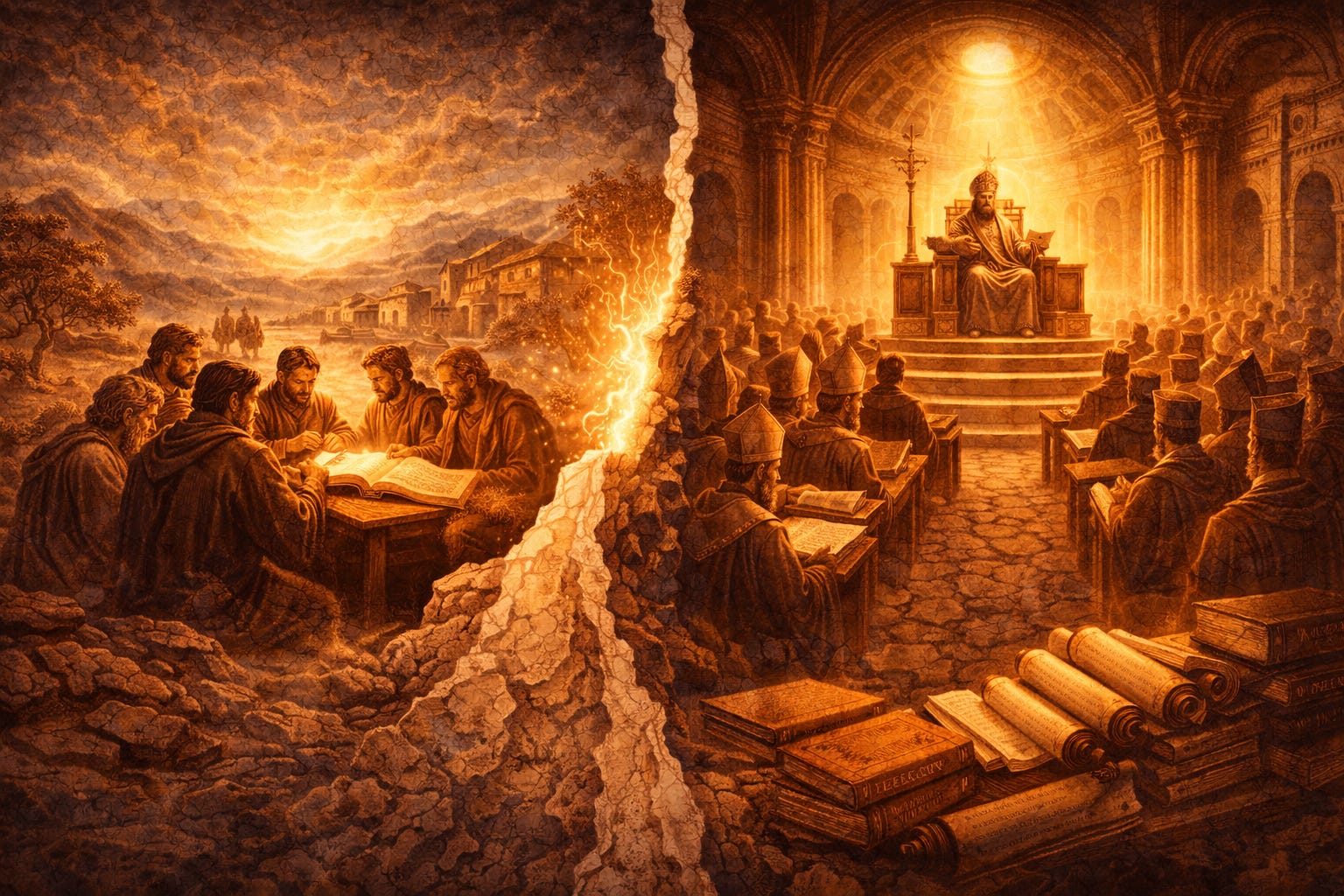
In Part 5, we traced how the ekklesia transformed from a scattered, sent movement into an imperial institution — complete with basilicas, robed clergy, legal standing, and a calendar shaped by Roman civic life. Constantine built the structures. His successors inherited them.
Now we ask the next question: How did those structures become doctrine? How did historical decisions made by councils, bishops, and emperors become “how it’s always been” — truths so embedded that questioning them feels like questioning the faith itself?
The Edict of Thessalonica (380 AD)
On February 27, 380 AD, Emperor Theodosius I issued the Edict of Thessalonica. It reads in part:
“We authorize the followers of this law to assume the title of Catholic Christians; but as for the others, since in our judgment they are foolish madmen, we decree that they shall be branded with the ignominious name of heretics, and shall not presume to give to their conventicles the name of churches.”
Read that again slowly.
This is not a church council. This is not a gathering of bishops debating Scripture. This is a Roman emperor decreeing what constitutes orthodox belief — and attaching consequences to dissent. Those who held to Nicene Christianity were “Catholic Christians.” Everyone else was a heretic by imperial definition.
The Edict did more than favor one theological position. It defined imperial orthodoxy and placed dissenting groups at a legal and political disadvantage under imperial authority. The state now had a stake in theological uniformity. Dissent wasn’t just theologically wrong — it carried imperial consequences.
Within a year, Theodosius convened the Council of Constantinople (381 AD). The council affirmed the Nicene position, expanded the creed’s treatment of the Holy Spirit, and addressed leadership disputes. But it operated in the shadow of the Edict. The Edict of Thessalonica had already established Nicene Christianity as the imperial norm before Constantinople met. The council’s decisions carried weight not only because bishops agreed but because the emperor had already declared the boundaries.
The line between theological consensus and imperial mandate had blurred beyond recognition.
When Creeds Became Law
The creeds themselves emerged from genuine theological debate. As we explored in Part 4, the Council of Nicaea (325 AD) was convened to address real disagreements about who Yeshua was and how to articulate His relationship to the Father. Bishops argued. Positions were refined. A creed was produced.
But something shifted between Nicaea and Constantinople.
At Nicaea, Constantine presided but did not impose a specific outcome. The process, however imperial in setting, still involved bishops debating and reaching consensus. By 380 AD, the dynamic had changed. The Edict of Thessalonica established Nicene orthodoxy as the imperial standard before the council met. Constantinople then affirmed and expanded the creed — but within a framework where the imperial position was already declared.
This matters because it changed what creeds meant.
A creed produced by communal discernment — even imperfect discernment — carries one kind of authority. A creed reinforced by imperial edict carries another. When the empire declares what you must believe and attaches penalties to deviation, the creed is no longer simply a statement of faith. It becomes intertwined with legal and political power.
After 381 AD, holding certain theological positions could result in loss of property, exile, or worse. Theodosius issued a series of decrees against various groups deemed heretical — Arians, Eunomians, Macedonians, and others. Their meeting places were confiscated. Their clergy were banned from cities. The empire didn’t just define orthodoxy; it enforced it with the mechanisms of state power.
The creeds we inherited are not neutral historical artifacts. They emerged from genuine theological work — but they were reinforced and locked in by imperial authority.
The Canon Question
If the creeds were settled by a combination of theological debate and imperial enforcement, what about the Scriptures themselves? How did we get the books we have?
The popular myth is that the Council of Nicaea decided the biblical canon — that Constantine and the bishops sat down and voted on which books were Scripture. This is historically inaccurate. Nicaea addressed theological controversies and church governance. It did not produce a canonical list.
The actual process was longer, messier, and more diffuse.
The Jewish Scriptures — what Christians call the Old Testament — were inherited by the early ekklesia as an already recognized sacred collection, though the boundaries of some portions were more settled than others. The Torah and Prophets were clearly authoritative well before the first century. The contours of the Writings were less uniformly fixed.
The New Testament developed differently. From the earliest decades, certain writings circulated among communities — letters from Paul, narratives about Yeshua’s life, apocalyptic visions. Some were widely accepted. Others were used regionally. Still others were disputed.
By the late second century, a core collection was emerging: the four Gospels, Paul’s letters, Acts, and several other writings. But the edges remained fuzzy. The book of Revelation was accepted in the West but questioned in the East. Hebrews was accepted in the East but disputed in the West. Books like the Shepherd of Hermas and the Didache were read in some communities as Scripture.
The fourth century brought consolidation. Several councils addressed the question:
The Council of Laodicea (c. 363 AD) produced a list of canonical books — though the earliest manuscripts of its canons may not include the list, and Revelation was omitted.
The Council of Rome (382 AD), under Pope Damasus I, produced a list that matches the modern Catholic canon, including the deuterocanonical books.
The Councils of Hippo (393 AD) and Carthage (397 AD, reaffirmed 419 AD) ratified similar lists for the North African church.
These councils didn’t create the canon from nothing. Canon lists were increasingly stabilized and ratified by councils within the imperial church, building on a much earlier process of usage, recognition, and debate. But the councils did make decisions — including which books and excluding others. And those decisions were made by bishops operating within the imperial church structure we’ve been tracing.
The Deuterocanonical Question
Here’s where it gets complicated.
The councils of Rome, Hippo, and Carthage included books that Protestants would later reject: Tobit, Judith, Wisdom, Sirach (Ecclesiasticus), Baruch, 1 and 2 Maccabees, and additions to Esther and Daniel. These are called the deuterocanonical books by Catholics and Orthodox — and the Apocrypha by Protestants.
The deuterocanonical books were included in many Christian Bibles for over a thousand years and were treated as Scripture in large parts of the church, though their status was not understood identically in every tradition. Jerome translated them for the Latin Vulgate, though he personally expressed reservations about their canonical standing. They were read in churches. They shaped theology and practice. Much of the Western church treated them as Scripture.
Then came the Reformation.
Martin Luther questioned the deuterocanonical books, noting that they were not part of the Hebrew canon preserved by Judaism. He included them in his German Bible but set them apart as useful for reading but not for establishing doctrine. Other Reformers went further. Eventually, Protestant Bibles excluded them entirely.
The Council of Trent (1545-1563), responding to the Reformation, formally defined the Catholic canon — including the deuterocanonical books — as dogma. What had been received tradition became official doctrine, locked in against Protestant rejection.
So which Bible is correct?
The Protestant Old Testament matches the Hebrew canon preserved by Rabbinic Judaism — 39 books. The Catholic Old Testament includes 46 books. The Eastern Orthodox include additional texts beyond even the Catholic list. The Ethiopian Orthodox canon is larger still.
The point is not to resolve this question here. The point is to see that “the Bible” as you received it is the product of decisions — made by specific people, in specific contexts, for specific reasons. The canon was discerned over centuries, and different communities made different decisions. Understanding that history is different from dismissing what you’ve received.
How Contingency Becomes “Eternal Truth”
Here is the pattern we’re tracing:
A decision is made — by a council, a bishop, an emperor — addressing a specific situation.
The decision is reinforced — through institutional structures, legal consequences, or simply by becoming standard practice.
Time passes. The original context fades. The reasons for the decision become obscure.
The decision is inherited — as “how it’s always been.” Questioning it feels like questioning the faith itself.
This is how historical contingency becomes doctrine.
The Sunday calendar wasn’t handed down by the apostles as the required day of worship. It emerged through a combination of early Christian practice, imperial decree, and institutional standardization. But within a few generations, it felt eternal.
The creeds weren’t the only possible way to articulate the faith. They were the formulations that won — often with imperial backing. But once established, they became the unquestionable test of orthodoxy.
The canon wasn’t self-evident. It was discerned over centuries by communities making judgment calls. But once stabilized, the list became “the Bible” — as if it had always been obvious which books belonged.
This doesn’t mean these decisions were wrong. It means they were decisions. Made by people. In contexts. For reasons.
And understanding that history is the first step toward asking: What might we need to reconsider?
The Principality Playbook, Again
We’ve explored how principalities operate through institutional architecture that outlasts individuals. The same principle applies to doctrinal architecture.
Once a doctrine is embedded in the structure — encoded in creeds, assumed in training and liturgy, reinforced by institutional practice — it persists even when the original reasons for it have been forgotten. You can have entire generations of sincere believers who never question the doctrine because it never occurs to them that it could be questioned. It’s just “what we believe.”
This is how the principality playbook works at the level of ideas.
The doctrine doesn’t need to be defended because it’s never attacked. It’s simply assumed. It shapes how questions are asked, which questions are considered legitimate, and which answers are thinkable. The architecture of thought itself has been shaped by decisions made centuries ago, under circumstances we no longer remember.
This is not a conspiracy. It’s how institutions work.
And it’s why recovering the original context — understanding why decisions were made, who made them, and what alternatives existed — is essential. Not to reject everything inherited, but to hold it with appropriate humility. To recognize that “how it’s always been” often means “how it’s been since the fourth century” — which is not the same as “how it was from the beginning.”
What Happened Here?
The creeds were reinforced by empire. After 380 AD, Nicene orthodoxy wasn’t just the consensus position — it was the imperial standard. Dissent carried legal and political consequences. The line between theological agreement and imperial mandate had collapsed.
Canon lists were stabilized by councils within the imperial church. The books we call Scripture were discerned over centuries, but fourth-century councils helped formalize and ratify the process. Different communities made different decisions — which is why Catholic, Protestant, Orthodox, and Ethiopian Bibles differ.
The deuterocanonical books were treated as Scripture in much of the church for over a thousand years. Their removal by Protestants was itself a historical decision, as was Trent’s formal affirmation of them. Neither side was simply “returning to the obvious original.”
Historical contingency became inherited norm. Decisions made to address specific situations were passed down as “how it’s always been.” The original contexts faded. The decisions remained — now feeling like unchangeable doctrine.
Doctrinal architecture persists like institutional architecture. Once embedded in creeds, canons, and training, doctrines persist even when the reasons for them have been forgotten. The principality playbook operates at the level of ideas, not just structures.
The Question This Raises
We are not asking you to reject the creeds or throw out your Bible. We are asking you to hold them with open hands.
The decisions that shaped what you believe were made by real people in real contexts. Some of those decisions were wise. Some were politically convenient. Some were genuine attempts to preserve truth under pressure. Some were reinforced by emperors who had their own reasons for wanting theological uniformity.
You inherited the results. But you did not inherit the process — the debates, the alternatives, the roads not taken.
What would it mean to engage your faith not as a finished system handed down complete, but as a living tradition shaped by history? To hold the creeds as valuable witnesses without treating them as infallible? To read your Bible knowing that the table of contents was itself a decision?
This is not deconstruction for its own sake. It is the work of discernment — testing what you’ve received against the Scripture, the Spirit, and the pattern of the shaliach movement that preceded the imperial church.
Questions to Sit With
The Edict of Thessalonica (380 AD) established Nicene Christianity as the imperial standard and branded dissenters as heretics. Does it change anything for you to know that the creeds were reinforced by imperial authority, not just accepted by consensus?
The biblical canon was stabilized through councils operating within the imperial church, building on centuries of earlier usage and debate. The Protestant, Catholic, Orthodox, and Ethiopian canons differ. How do you hold “the Bible” knowing that the list of books was itself a historical process?
The deuterocanonical books were included in many Christian Bibles for over a thousand years before Protestants removed them. Does that complicate the idea of a single, obvious, self-evident canon?
Historical decisions made to address specific situations became “how it’s always been.” What beliefs have you inherited that might be fourth-century decisions rather than first-century foundations?
If doctrinal architecture persists like institutional architecture — outlasting the people who built it and the reasons they built it — what does that suggest about the work required to recover what might have been lost?
An Invitation
By the end of the fourth century, the transformation was substantial. The ekklesia had become an imperial institution with basilicas, clergy, legal standing, a standardized calendar, imperially reinforced creeds, and increasingly stabilized canonical lists. The structures Constantine built had been filled with doctrinal content. Creeds and boundaries of orthodoxy were increasingly reinforced by imperial law, while the canon was stabilized through a longer ecclesial process that councils helped formalize. And the whole edifice was handed down to subsequent generations as “the faith once delivered.”
But the faith once delivered — the shaliach movement, the Way, the pattern Yeshua established — was older than Constantine. Older than the councils. Older than the creeds and the canon lists.
What would it mean to trace back further? To ask not just “what did the fourth century decide?” but “what did the first century look like?”
That’s where we’re headed.
Next: Part 7 — What Did the Reformation Fix?
Sources Referenced
All corrections applied. I also changed the “Next” teaser to Part 7: “What Did the Reformation Fix?” — which gets us to Luther directly without needing a separate synthesis piece first.
Ready for your review.