

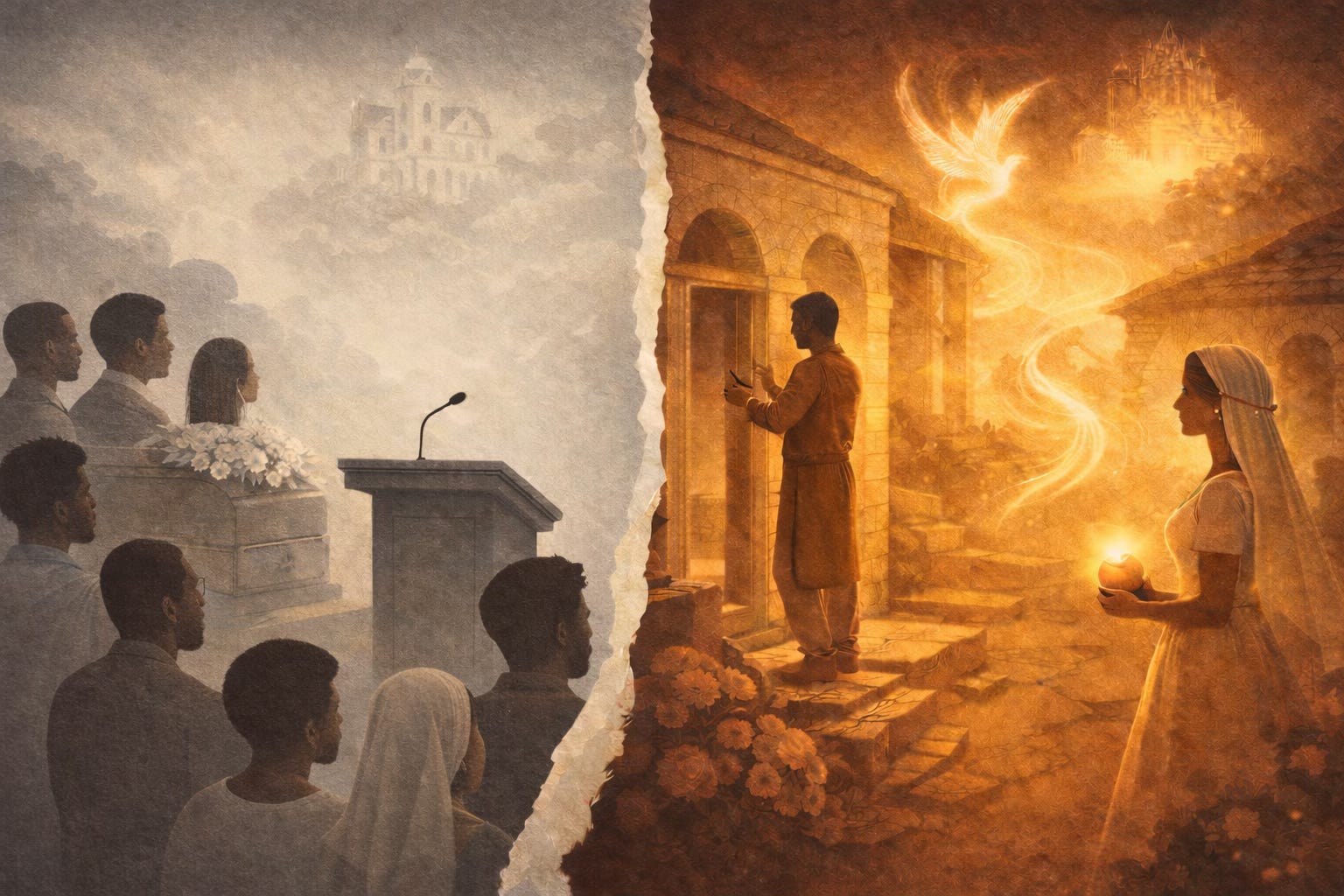
Picture a funeral.
The preacher opens to John 14:1–3 and offers familiar comfort:
“Your loved one has gone to the mansion Jesus prepared in heaven. One day you’ll join them there.”
This is the most commonly read passage at Christian funerals. John 14 has become synonymous with “going to heaven when you die.”
There’s only one problem: this passage isn’t about a funeral. It’s about a wedding.
It’s Thursday night. Last Supper. Upper room. Judas has just left to betray Yeshua. Peter has been told he’ll deny his Master three times. The disciples are terrified. Their rabbi is leaving, which feels like losing their access to God.
Abandonment. Death. Orphans.
So Yeshua speaks into their fear, not with a funeral sermon, but with Jewish betrothal language:
a bridegroom preparing space in his father’s house, promising to return for his bride.
He’s not offering vague comfort about dying someday. He is preparing them for what happens in seventy-two hours… and for what happens fifty days later at Pentecost when the Spirit comes.
We’ve been reading covenant wedding language as if it were only funeral language, and in doing so we’ve reversed what Yeshua promised.
He said He would come to us.
We made it about us going to Him.
He promised the Father and Son would make their home in believers.
We made it about believers making their home in heaven.
What if John 14 is about the Bridegroom returning to earth for His bride, not the bride escaping earth for heaven? What if the “place” He prepared isn’t celestial real estate but Spirit-indwelt believers becoming God’s dwelling place on earth?
Let’s read it again, not at a funeral, but at a wedding rehearsal.
Scripture: The Living Word
Key verses for our focus:
Verses 1–4:
“Do not let your heart be troubled. Trust in God; trust also in Me. In My Father’s house there are many dwelling places. If it were not so, would I have told you that I am going to prepare a place for you? If I go and prepare a place for you, I will come again and take you to Myself, so that where I am you may also be. And you know the way to where I am going.”
(John 14:1–4)
Verse 17:
“…the Ruach of truth, whom the world cannot receive because it does not see Him or know Him. You know Him, because He abides with you and will be in you.”
(John 14:17)
Verse 18:
“I will not leave you as orphans; I will come to you.”
(John 14:18)
Verse 23:
“If anyone loves Me, he will keep My word. My Father will love him, and We will come to him and make Our dwelling with him.”
(John 14:23)
Verse 28:
“…If you loved Me, you would rejoice that I am going to the Father, because the Father is greater than I.”
(John 14:28)
Context: Behind the Words
First-century Jewish weddings had three distinct phases:
1) Erusin (betrothal)
Covenant established. Bride price (mohar) paid to the father. Marriage contract (ketubah) signed. A gift (mattan) given to the bride. The couple is legally married, but not yet cohabiting.
2) Preparation period
The groom returns to his father’s house to prepare a place for his bride. The bride prepares herself. This separation could last up to a year.
3) Nissuin (consummation)
The groom returns with a procession to collect his bride, brings her to the prepared home, and the wedding feast begins.
That mattan mattered. It was the groom’s personal gift to his bride at betrothal. A tangible proof of commitment she possessed during their separation.
Yeshua is using this imagery deliberately. The disciples just can’t grasp what He’s actually promising.
The Aramaic reveals what’s hidden in translation
“Baita d’Avi” (Father’s house) echoes both temple language (Beit HaMikdash—God’s dwelling place among His people) and household compound (where generations lived together).
When Yeshua cleansed the temple in John 2:16, He called it “My Father’s house.” But He also predicted its destruction and replacement with His own body:
“Destroy this temple, and in three days I will raise it up.”
(John 2:19–21)
The Father’s house isn’t merely a distant address in the sky. It is wherever God dwells with His people.
“Atra” (dwelling places/rooms) means prepared spaces within the family compound. In wedding customs, the groom prepared an atra in his father’s house for his bride. This isn’t about isolated heavenly real estate. It’s about permanent belonging within the Father’s household.
Critical: the disciples don’t yet know the Ruach personally
Verse 17 is explicit:
“He abides with you and will be in you.”
(John 14:17)
Future tense.
This hasn’t happened yet. It cannot happen until after Yeshua’s death, resurrection, and ascension.
In Jewish understanding, the Spirit came upon certain people at certain times—Moses, David, the prophets—for specific empowerment. But the prophets promised a future day when God would pour out His Spirit broadly and permanently:
“I will pour out My Spirit on all flesh…” (Joel 2:28–29)
“I will put My Spirit within you…” (Ezekiel 36:26–27)
That was eschatological hope, not present experience.
The disciples had categories for this as distant promise. They had no experiential reference for what Yeshua is describing: that within weeks, the Spirit would dwell in them permanently, giving them internal, intimate, continuous access to divine presence.
John 7:37–39 foreshadows it:
Yeshua promised “rivers of living water” would flow from believers. John adds the key detail:
“Now He said this about the Spirit, whom those who believed in Him were to receive, for the Spirit had not yet been given, because Yeshua was not yet glorified.”
(John 7:39)
So what is Yeshua “preparing”?
Not heavenly mansions.
He is preparing the way for Spirit-indwelling that makes believers into God’s dwelling place on earth.
This is the sequence:
Cross pays the bride price and establishes covenant
Resurrection glorifies the Bridegroom
Ascension enthrones Him at the Father’s right hand
Pentecost delivers the gift: the Spirit now dwells within believers
Then John 14:23 makes it stunningly explicit:
“We will come to him and make Our dwelling with him.”
Not believers going away to dwell with God somewhere else, but God coming to dwell in believers right here on earth through the Ruach.
Heaven invading earth, not earth’s faithful evacuating to heaven.
The Spirit as mattan with arrabōn function
Paul recognizes the Spirit as this gift, and even more.
Writing to Greek audiences familiar with commercial transactions, Paul uses the term arrabōn (ἀρραβών): a deposit, down payment, guarantee. It’s borrowed from the Hebrew ʿeravōn (עֲרָבוֹן) in Genesis 38:17–20.
Paul says the Spirit is God’s guarantee:
The Spirit is Yeshua’s mattan to His bride, and it carries arrabōn force: a gift you possess now that guarantees the full completion later.
Put plainly: the Spirit is the engagement gift that makes abandonment impossible.
The betrothal timeline applied
Cross = bride price paid, covenant established
Pentecost = mattan delivered: the Spirit indwells believers
Current age = preparation period (bride making herself ready, possessing the guarantee)
Second Coming = wedding procession returns to gather the bride for the feast on renewed creation
The direction matters
Yeshua keeps emphasizing movement toward His people:
John 14:3 — “I will come again…”
John 14:18 — “I will not leave you as orphans; I will come to you.”
John 14:23 — “We will come to him…”
John 14:28 — “I am going away, and I am coming back to you.”
That is not the language of abandonment with a distant relocation plan. That is the language of a Bridegroom promising return.
And this matches the larger biblical trajectory. The ultimate hope is not escape, but descent and dwelling: heaven and earth united.
Revelation confirms the pattern:
New Jerusalem comes down
God tabernacles with humanity
Creation is renewed, not abandoned
Revelation 21:2–3 makes it plain:
“The tabernacle of God is with men, and He shall dwell with them.”
The movement is consistently downward: heaven to earth, not earth to heaven.
And this doesn’t erase comfort for those who die in Messiah. Death is real, and grief is real. But New Testament hope is not evacuation. It is resurrection (1 Corinthians 15).
Covenant: The Relational Core
“Going to heaven” theology often neutralizes Yeshua’s actual promise.
If the goal is post-death paradise, then present systems become tolerable. Injustice becomes background noise. Empire becomes “just the world we live in.” Religion becomes safely private and future-focused instead of publicly disruptive now.
But wedding theology transforms everything.
1) Funeral theology is individualistic
“You’ll go to your mansion when you die.”
Wedding theology is communal. We are the bride being prepared as a corporate body for consummation. Your preparation affects mine. Our readiness is collective.
2) Funeral theology is passive
“Wait for heaven.”
Wedding theology is active.
Revelation 19:7–8 says:
“The bride has made herself ready… Fine linen stands for the righteous acts of God’s holy people.”
The bride prepares through costly obedience, Spirit-empowered transformation, and actual righteousness, not comfortable waiting.
3) Funeral theology makes earth disposable
“This world is not our home.”
Wedding theology makes earth central.
This earth is not being discarded. It is being renewed. This creation restored is the location of the feast. What you do with your body, your resources, this land matters permanently.
4) The mattan demands response
Yeshua said:
“Whoever believes in Me will do the works I have been doing, and they will do even greater works than these, because I am going to the Father.”
(John 14:12)
Greater works, not because we’re superior, but because the gift He sent enables what His physical presence could not.
One incarnate body could walk Galilee.
But the Spirit indwelling millions can embody the presence of God across the world at once.
So the question becomes unavoidable:
What are you doing with the gift that cost your Bridegroom His life?
The Spirit isn’t a spiritual bonus. He is empowerment for kingdom work now.
Are you embodying divine presence inside unjust systems?
Redistributing resources?
Confronting empire?
Practicing costly righteousness?
Or have you reduced the Spirit to personal comfort while waiting for evacuation?
Funeral theology offers cheap comfort: “Your loved one is pain-free in heaven.”
Wedding theology offers costly hope: death is rest during preparation, awaiting resurrection, when heaven and earth unite and all things are made new.
Empire religion asks: “Are you going to heaven when you die?”
Kingdom covenant asks:
Are you making yourself ready for the wedding? What are you doing with the engagement gift you’re carrying?
Practice: Living It Out
Reading John 14 as wedding preparation rather than funeral comfort fundamentally reframes discipleship.
We are not passively waiting for death to transport us elsewhere. We are actively preparing as a bride during betrothal, possessing the Spirit as proof that the Bridegroom is returning to earth.
This makes obedience urgent.
Embodied life sacred.
Creation central.
And covenant faithfulness present-tense.
The question isn’t “Will you go to heaven when you die?”
It’s “Are you making yourself ready for the wedding?”
Three Key Takeaways
John 14 is wedding preparation language, not funeral comfort language. The promise is the Bridegroom’s return, not the bride’s departure.
The “place” Yeshua prepared is Spirit-indwelt believers becoming God’s dwelling place on earth. The Father’s house is wherever the covenant community embodies divine presence.
The Spirit functions as mattan with arrabōn guarantee. The gift we possess now proves the Bridegroom will complete what He began and empowers “greater works” than Yeshua’s physical presence allowed.
Three Discussion Questions
How does reading John 14 as wedding preparation rather than funeral comfort change what Yeshua is actually promising? What does the Bridegroom’s return (rather than the bride’s departure) mean for how we live now?
If the Spirit’s indwelling is the mattan, the engagement gift proving the Bridegroom’s commitment and return, what does it mean that we possess that gift right now? How should this transform our embodiment of kingdom reality during the preparation period?
Yeshua promised we would do “greater works” because He was sending the Spirit (John 14:12). What are you doing with the gift that cost your Bridegroom His life? Where have you settled for personal comfort instead of costly bridal preparation?
Seven-Day Practice Rhythm
Day 1 — Subtract evacuation theology
Identify one specific thing you’ve avoided or neglected because you believed earth was temporary and heaven was the real destination. Write it down. Stop using “going to heaven” as justification for withdrawal.
Day 2 — Recognize the gift
The Spirit indwells you now: God’s down payment, the engagement gift. Notice when you treat this as a spiritual accessory instead of covenant reality. Where do you live like someone abandoned rather than someone betrothed?
Day 3 — Honor the temple
Your body is God’s dwelling place on earth right now. Examine one area—food, rest, sexuality, work—where your choices ignore that the Spirit lives here. What needs to change? (See 1 Corinthians 6:19–20.)
Day 4 — Face the cost
Revelation 19:7–8 says the bride makes herself ready through righteous acts. What is the Spirit calling you to that will cost something real: resources, comfort, reputation, time? Name it specifically.
Day 5 — Choose one righteous act (with community)
Don’t only think about Day 4. Do it. Take one concrete action this week that embodies kingdom reality and costs you something. If possible, let it strengthen covenant community: restoration, reconciliation (Matthew 18:15–20), provision (James 2:14–17), accountability (Hebrews 10:24–25).
Day 6 — Examine your hope
Is your ultimate hope escaping earth for heaven, or the Bridegroom returning to renew earth (Revelation 21:1–5)? How does that difference change what you invest in now? Where does funeral theology still shape your choices?
Day 7 — Rest in the guarantee
The Spirit is God’s arrabōn: the down payment guaranteeing completion (Ephesians 1:13–14). You are not waiting in uncertainty. You are betrothed. Let that confidence reshape how you enter the week ahead.
Closing Blessing
May you live as one betrothed, not one waiting to die.
May the Spirit—the mattan given at such cost, the arrabōn guaranteeing completion—empower you to do the greater works your Bridegroom promised (John 14:12).
May you prepare yourself through righteous acts that cost something real, knowing this earth is being renewed for the wedding feast (Revelation 19:7–9).
And may you wear the engagement gift with confidence, embodying divine presence on earth, until the day the Bridegroom returns.
The Bridegroom is coming. Don’t live like an orphan.