

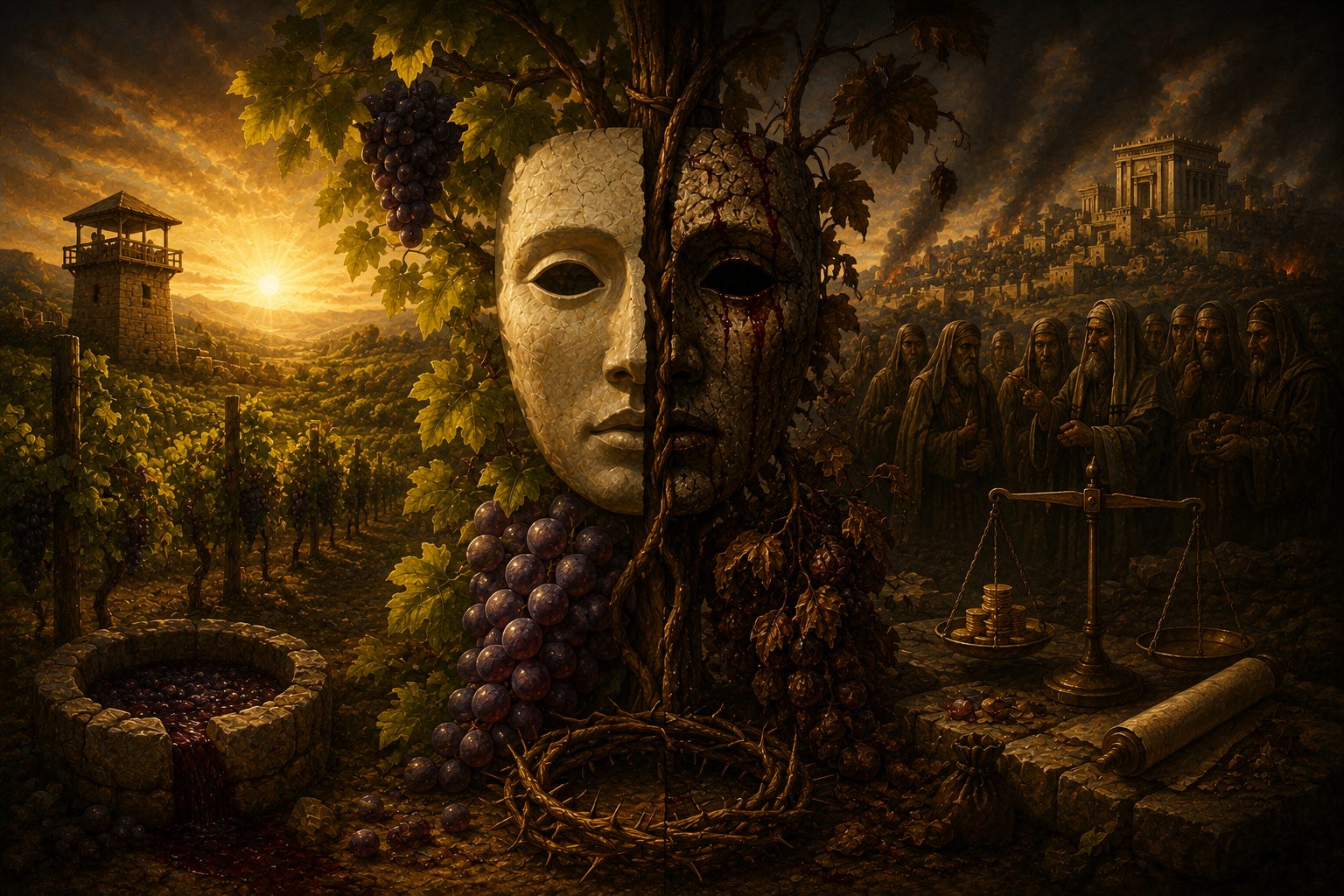
We live in a world where power hides behind righteousness. Systems of extraction call themselves “order.” Hierarchies that concentrate wealth and crush the vulnerable dress themselves in the language of authority and blessing. The mask is so convincing that the people wearing it often believe they are serving justice itself. Evil calls itself good with such confidence that it becomes nearly invisible.
But here is the sharper question: when a covenant community becomes corrupt, where does that corruption originate? Does it come from external enemies battering at the gates? Or does it come from the choices we make inside our own walls?
The answer, as it turns out, is both. But only one of them gets indicted by Scripture. And that indictment falls entirely on us.
To understand why, we need to investigate Isaiah 5. Because what the prophet saw in ancient Judah — and what YHWH was calling them to see about themselves — is exactly what we need to see about ourselves today.
Scripture
Read the full chapter: Isaiah 5:1-30 (NIV)
Isaiah 5 unfolds in three movements: a love song about a vineyard that turns into a courtroom (verses 1-7), six woes naming exactly what the corruption looked like (verses 8-23), and the verdict, executed by an empire summoned with a whistle (verses 24-30).
The entire chapter turns on a single verse. This is where the song becomes the trap:
The vineyard of the Lord Almighty
is the nation of Israel,
and the people of Judah
are the vines he delighted in.
And he looked for justice (mishpat),, but saw bloodshed (mishpach)
for righteousness (tzedakah) but heard cries of distress (tze’akah)
Four Hebrew words. Two pairs. Read them again slowly:
Mishpat (מִשְׁפָּט) — justice. The right ordering of life according to Yahweh’s standard. Honest courts, fair dealing, protection of the vulnerable.
Mishpach (מִשְׂפָּח) — bloodshed, oppression. Violence against the innocent. One letter away from mishpat.
Tzedakah (צְדָקָה) — righteousness. Covenant faithfulness lived out toward Yahweh and toward neighbor.
Tze’akah (צְעָקָה) — a cry of distress. The sound the oppressed make. The same word for the cry Israel raised under Egypt. One letter away from tzedakah.
Each word differs from its counterpart by a single letter. They look nearly identical on the page. They sound nearly identical in the ear. They are moral opposites.
Yahweh came looking for justice and found its counterfeit wearing its clothing.
Context
A Song With a Trap Inside
Isaiah 5 opens with the words “Let me sing for my beloved a song.” This is composed poetry, crafted to be performed aloud, and many scholars believe Isaiah delivered it at a harvest festival, possibly Sukkot, when crowds filled Jerusalem. Picture the scene. A singer stands up during the celebration. He begins what sounds like a vintage song, a love song about a man and his vineyard. The crowd leans in. This is entertainment.
By verse 3 the singer has them rendering judgment on the vineyard. Of course the owner should tear it down. It got everything and produced rot. The crowd agrees.
Then verse 7 lands and the trap closes. You are the vineyard.
It is the same move the prophet Nathan made with King David. Tell a story that draws the verdict out of the audience, then turn the mirror: you are the man. Isaiah made the crowd convict themselves before they knew they were on trial.
The wordplay is the punchline of the whole composition. In an oral culture, the ear does the work the page does for us. When Isaiah sang that Yahweh looked for mishpat and the crowd heard mishpach land in its place, the shock was audible. One letter. One sound. The word they expected and the word they received were nearly identical, and they were moral opposites.
Isaiah engineered that pun to teach something the definitions alone cannot teach. The counterfeit lives one letter away from the real thing. Injustice does not announce itself as injustice. It arrives sounding almost exactly like justice. It occupies the same courts, uses the same vocabulary, wears the same robes. The distance between righteousness and a cry of anguish is a single step, taken while telling yourself you are still standing in the same place.
The World Isaiah Was Singing Into
Isaiah was called around 740 BC, the year King Uzziah died. To understand why this song needed to be sung, you have to understand what the previous fifty years had done to Judah.
Uzziah’s long reign had been an economic golden age. Territory expanded. Trade routes opened. Agriculture flourished. Jerusalem’s elite grew wealthy in ways their grandparents could not have imagined. And that wealth had been accumulating into fewer and fewer hands. Archaeology from this period shows the pattern: large estates swallowing small family farms, luxury goods concentrating in the cities, the gap between the powerful and the poor widening into a canyon.
Here is why that matters for reading the woes. Under Torah, land was covenant inheritance. Every family held a permanent stake in the promise, and the land laws existed to keep it that way. What the elite were doing, adding house to house and field to field until they dwelt alone in the land, was more than greed. It was the dismantling of the covenant economy itself, done legally, through debt, through courts they controlled, through instruments that all looked proper on paper.
Then the external pressure arrived. Assyria, under Tiglath-Pileser III, was expanding westward with a brutality the region had never seen. To the north, Israel and Syria were forming coalitions and pressuring Judah to join. War was coming from multiple directions. The old securities were cracking.
And that pressure became the justification. Consolidation of land could be called national security. Concentration of power could be called stability. Courts that favored the strong could be called order. The elite of Judah took the logic of the empires around them, the logic where power justifies itself, and dressed it in covenant language. They did not abandon the vocabulary of justice. They kept every word and inverted every meaning.
That is what Isaiah walked into with a song. A community that still spoke fluent mishpat while producing mishpach, and had gotten so practiced at the substitution that they could no longer hear the difference. The woes that follow are Isaiah naming, one by one, what the inversion looked like on the ground: the land grabs, the escape into indulgence, the mockery of accountability, the redefining of good and evil, the self-certified wisdom, the courts for sale.
And the chapter’s final irony: the empire they used to justify it all is the instrument Yahweh whistles for to judge it. The threat they pointed at to excuse the corruption becomes the answer to it. The danger was never coming from outside. It was summoned by what they chose inside.
Covenant
Yeshua Walks Back Into the Vineyard
Seven centuries after Isaiah sang his song, Yeshua stood in the Temple courts, facing the religious leadership of the covenant community, and told a story about a vineyard.
Listen to the opening details. A landowner planted a vineyard. He put a wall around it. He dug a winepress in it. He built a watchtower. Every element is lifted straight from Isaiah 5. Yeshua is quoting the song. And every priest and scribe standing in that courtyard knew the melody, because Isaiah 5 was their Scripture. The moment he said “vineyard,” they knew which vineyard.
But Yeshua turns the indictment a notch further. In Isaiah’s song, the vineyard itself produced rot. In Yeshua’s version, the vineyard is fine. The problem is the tenants, the ones entrusted with managing it, who decided the vineyard belonged to them. They beat the servants sent to collect the fruit. Then they killed the son, reasoning that with the heir gone, the inheritance would be theirs.
And then Yeshua runs Isaiah’s play exactly. He asks the audience to render the verdict: what will the owner do to those tenants? They answer with their own mouths: he will bring those wretches to a wretched end and lease the vineyard to tenants who will give him the fruit. The trap closes. Matthew records that the chief priests and Pharisees knew he was speaking about them. Nathan to David. Isaiah to Judah. Yeshua to the Temple establishment. The covenant community convicting itself before it realizes it is on trial.
The Same Inversion, Fully Ripened
What Isaiah diagnosed as a disease, Yeshua confronted at full bloom. Look at how precisely the pattern repeats.
Isaiah’s generation kept the vocabulary of justice while producing bloodshed. Yeshua’s generation kept the vocabulary of Torah while nullifying it. In Mark 7:9-13, Yeshua names it directly: they had developed a tradition called korban, where a man could declare his wealth devoted to God and thereby escape the command to support his aging parents. Religious language deployed to cancel covenant obligation. Calling evil good, with a liturgical seal on it.
Isaiah pronounced six woes on the inverters. Yeshua pronounced his own woes on the scribes and Pharisees in Matthew 23, and they run on the same axis: you tithe your spices and abandon the weightier matters of Torah, justice, mercy, faithfulness. You clean the outside of the cup while the inside stays full of greed. You look like whitewashed tombs. Appearance kept, substance replaced. Mishpat on the lips, mishpach in the courts.
And then the inversion reached its logical end point. When the religious establishment could not deny the works of Yeshua, they attributed them to Beelzebul (Matthew 12:22-32). Stand back and see that moment through Isaiah 5:20. Here is the work of the Ruach HaKodesh, healing and delivering in front of their eyes, and the guardians of the covenant call it demonic. Light named darkness. Good named evil. That is why Yeshua treats that accusation with such gravity. It is the inversion consummated: a community so practiced at the substitution that it looks directly at the work of Yahweh and calls it satanic.
The Pattern Did Not Die With the Temple
Here is where the mirror starts turning toward us, because the vineyard did not close in 70 AD.
The same mechanics Isaiah named have operated in the covenant community in every generation since, including the ones that carry Yeshua’s name. External pressure arrives, real pressure, and the community absorbs the logic of the empire around it, then baptizes that logic in covenant language. Rome’s hierarchy became church hierarchy and was called divine order. Conquest was called mission. Wealth extraction was called stewardship and blessing. Comfort was called peace. Nationalism was called faithfulness. The vocabulary never changed. Every word stayed. Every meaning moved.
And notice what we do with Isaiah 5 and Matthew 23 when we read them. We read them as indictments of someone else. The Pharisees. The corrupt church of history. The compromised congregation down the road. The culture out there calling evil good. We stand with the crowd at the festival, nodding along, rendering judgment on the vineyard.
That posture is itself the warning sign. Both times this song was sung, it was sung to the covenant community, about the covenant community, and the listeners’ certainty that it applied to someone else was the very blindness being described. The one letter of distance between mishpat and mishpach is the distance between hearing this chapter as a mirror and hearing it as ammunition.
So the question Isaiah’s song forces on us is concentric, and it starts at the center. Not “where is the world inverting good and evil,” that answer is easy and it costs us nothing. The covenant question is: where have I kept the vocabulary and moved the meaning? Where has our community dressed the logic of the surrounding culture in the language of Yahweh? What are we currently calling blessing, order, stewardship, wisdom, that would sound to Isaiah like mishpach wearing mishpat’s clothing?
He expected justice. What is he finding in his vineyard now?
Practice
Isaiah’s song ended with the crowd discovering they were the vineyard. This is where we stand in front of the same mirror. Six woes, and each one is a station. At each station, the audit works concentrically. Self first. Then household. Then community. The order is the discipline. If you find yourself eager to answer the third question before you have sat with the first, that eagerness is itself the diagnosis.
Take these slowly. This is not a checklist to complete. It is an examination to undergo.
Station One: Accumulation
Isaiah 5:8-10 — joining house to house and field to field until you dwell alone in the land.
The woe is aimed at those who accumulate until no one else has room. Land then. For us: money, position, opportunity, security, control.
Self: What am I accumulating past the point of need, and what covenant language do I use to justify it? Where have I called hoarding “stewardship” or “providing for my family” when the honest word is fear, or appetite?
Household: Does the way our home handles resources leave room for others, or does everything flow inward? Would someone watching our spending conclude we believe Yahweh provides?
Community: Where does our community concentrate resources, influence, or voice in a few hands? Who has quietly been left with no place among us?
Station Two: Anesthesia
Isaiah 5:11-17 — feasts with harps and wine, and no regard for the deeds of Yahweh. Exile “for lack of understanding.”
The woe is aimed at those who numbed themselves with indulgence and entertainment until they could no longer see what Yahweh was doing. The exile came from a failure to pay attention.
Self: What do I reach for to avoid paying attention? Where has entertainment, scrolling, work, or even religious busyness become the wine I use to keep the deeds of Yahweh comfortably out of view?
Household: What does our home attend to together? If our evenings were audited, would they show a family watching for the work of His hands, or a family being entertained past it?
Community: Where has our gathered life become production and program, harps and tambourines, while attention to what the Ruach is actually doing has gone quiet?
Station Three: Mockery of Accountability
Isaiah 5:18-19 — dragging sin along with cords, saying “let God hurry, let us see it, then we will know.”
The woe is aimed at those who kept sin harnessed to themselves like a cart while daring judgment to show up. Functional atheism wearing theological language.
Self: What sin am I dragging behind me by choice, roped on, while telling myself there has been no consequence yet, so there will be none? Where does my life say “I will take it seriously when I see it”?
Household: What have we agreed not to talk about? What pattern in our home continues because no one is willing to name the rope?
Community: Where do we tolerate what we have privately agreed to stop confronting? Who in our community has been dragging a cart for years while we practice a silence we call grace?
Station Four: The Renaming
Isaiah 5:20 — calling evil good and good evil, darkness light and light darkness, bitter sweet and sweet bitter.
The woe at the center. The vocabulary kept, the meanings moved. This is the station where the whole lesson concentrates.
Self: What have I renamed? Where do I say “blessing” and mean comfort, “wisdom” and mean self-protection, “peace” and mean avoidance, “discernment” and mean contempt? Say the honest word out loud, alone, before Yahweh.
Household: What inversions have we taught, or modeled, without ever stating them? What do our children learn from us about what “good” means, measured by what we celebrate and what we excuse?
Community: What does the surrounding culture reward that we have baptized? Where would an outsider reading only our practices, never our words, conclude that our definitions of success, power, and blessing came from somewhere other than Scripture?
Station Five: Self-Certified Wisdom
Isaiah 5:21 — wise in their own eyes, clever in their own sight.
The woe is aimed at those whose wisdom answered to no one. The inversion protects itself by disqualifying every voice that could expose it.
Self: Who is permitted to correct me? Name them. If the list is empty, or if the list is only people who agree with me, this woe has found its address.
Household: Can the people who live with me question my judgment without paying a price for it? What does my reaction to challenge teach my family about what I actually worship?
Community: Have we built a culture where correction can travel in every direction, including upward? Or have we certified our own discernment and called the certification maturity?
Station Six: Purchased Judgment
Isaiah 5:22-23 — heroes at drinking, champions at mixing drinks, who acquit the guilty for a bribe and deny justice to the innocent.
The woe is aimed at those whose verdicts could be bought. The bribe for us is rarely cash. It is belonging, access, comfort, the favor of the strong.
Self: Where does my judgment bend toward whoever benefits me? Whose wrong do I refuse to see because seeing it would cost me a relationship, a position, an identity?
Household: Do we practice one standard for people we love and another for people we don’t? What do we let slide in our own tribe that we would condemn loudly in another?
Community: Who receives the benefit of the doubt among us, and who receives suspicion, and does the difference track righteousness, or does it track power, familiarity, and usefulness?
The Closing Discipline
End where the chapter ends. Isaiah 5 closes with Yahweh whistling for the very empire Judah had used to justify its corruption. The threat outside was summoned by the choices inside. So resist the final temptation this lesson will present to you: walking away with a sharpened eye for everyone else’s inversions. That would be attending the festival, nodding at the song, and missing that it was sung about you.
This week, take one station, the one that made you flinch, and sit in the self ring only. Name the honest word for the thing you renamed. Bring it to Yahweh as teshuvah, and to one trusted person as confession. The vineyard’s fruit is not restored community-wide first. It is restored one vine at a time.
He expected justice. Let him find it, beginning in you.
Closing Blessing
May Yahweh, the owner of the vineyard, who dug the soil and cleared the stones and planted you with His own hands, find in you the fruit He planted you to bear.
May the Ruach HaKodesh give you ears to hear the difference between mishpat and mishpach, the honest word and the renamed one, in a generation that can no longer hear it.
May you have the courage to sit in front of the mirror before you ever lift it toward another, and the humility to receive correction as covenant love.
May your household be a place where light is called light, where sweet is called sweet, where the vulnerable find room, and where the cry of the oppressed is answered instead of caused.
And when the Master of the vineyard walks your rows looking for justice, may He find it, growing in you, ripening in your house, and spreading through His people.
In the name of Yeshua, the Son who was sent to the vineyard, rejected by the tenants, and raised as the cornerstone.
Amen.