


Introduction
Ask most people who carry the name of Yeshua what love requires of them and you will get one of two answers, and both of them are ditches.
The first answer says love means telling the truth. Somebody has to say what is right and what is wrong, and if the world does not want to hear it, that is the cost of faithfulness. This ditch knows something real. Scripture draws lines, and a people who cannot say so have stopped reading.
The second answer says love means acceptance. The first ditch produced so much cruelty, so much shouting at strangers, so many people driven away from the Messiah by people wearing His name, that the only decent response left is to stop correcting anyone about anything. This ditch also knows something real. It watched what the first ditch did, and it refused to call that faithfulness.
Between the ditches there is a road, and Torah began laying it in the wilderness.
Love is the constant. It does not thin out as it moves away from you, and it does not run out at the edge of the covenant. What changes is the form love is able to take, and the thing that governs the form is covenant. Inside the covenant, love can tell you the truth about yourself, because you have agreed to that and so has the person telling you. Outside it, nobody agreed to anything, so the same words arrive as a verdict from a stranger. What belongs to the outsider is the invitation, which is the message Yeshua sent His people out carrying.
The picture that helps here is a camp. Rings around a center, everyone placed by nearness to the Presence, with a fire at the middle that can be seen from a long way off.
This lesson is about getting the rings in the right order, because much of what passes for faithfulness today is the camp turned inside out.
Scripture
Context: What the Words Actually Mean
One verb, one measure: ahav and kamokha
The verb is ahav (אָהַב). Leviticus 19 uses it twice in commands that most people never read together.
Verse 18 governs the re’a (רֵעַ), the neighbor, the fellow, the one beside you. Verse 34 governs the ger (גֵּר), the sojourner who dwells among the people. Same verb both times, and both times the same measure: kamokha (כָּמוֹךָ), as yourself.
Now the part that requires care, because it is easy to get wrong and I want us to get it right.
The ger is not the outsider. Torah gives the ger Shabbat rest, places him under one law with the native-born, includes him in the Day of Atonement, and opens Pesach to him when he is circumcised. The ger lives inside the camp, under the covenant, holding much of what Israel holds. He differs from the native-born in ancestry and in social standing, and Torah refuses to let either difference reduce what he is owed.
So verse 34 is not a command about the nations. It is a command about the man in the next tent whose grandfather was Egyptian. Which makes it more useful to us, and more uncomfortable, because that is the ring where the Western church still fails. We have never had much trouble loving people who look like us and came in the same door. Torah legislated against exactly that failure, in the same chapter, with the same word and the same measure, and it grounded the command in memory: for you were sojourners in the land of Egypt. You know what it is to be the one whose belonging gets questioned. Do not do it to him.
Where Yeshua takes the measure
Torah drew a line, and the line was real. Kamokha covered the brother and it covered the ger, and beyond that stood the nations, and Torah did not extend the command that far.
Then Yeshua stands on a hillside and says love your enemies.
That is the seed becoming the tree. He takes the measure Torah gave for inside the camp and applies it to the one person Leviticus never named, and He grounds it the way Torah grounded the ger command, in the character of the One giving it. The sun rises on the evil and the good. Rain falls on the righteous and the unrighteous. Yah is kind to the ungrateful, and His people are to be kind the same way, which means kindness that is not waiting on the other person to change.
Nothing is severed here. The root is Leviticus 19 and the growth is Matthew 5, and the direction is the same direction Torah was already moving, outward, from the brother to the ger to the enemy.
The doubled verb: hokheach tokhiach
Leviticus 19:17 uses the infinitive absolute, the Hebrew construction that doubles a verb for emphasis. Hokheach tokhiach (הוֹכֵחַ תּוֹכִיחַ). Reproving you shall reprove. Translators render it as you shall surely reprove or you shall reason frankly with.
What surrounds it is the part that gets skipped. The verse opens with you shall not hate your brother in your heart, and the reproof is what the text offers in place of that hatred. Contempt with nowhere to go settles in and stays. Torah’s answer is to go say the thing, out loud, to his face.
And the verse before it forbids going about as a rakhil (רָכִיל), a talebearer. Torah fences the reproof before it authorizes it. Anything that travels sideways through the camp before it reaches the person has already broken the commandment. Yeshua makes the procedure explicit in Matthew 18, and later Jewish reading of this verse insists on the same thing, that reproof must never shame a man in public.
The closing clause, and not bear sin because of him, has been read several ways. It may warn that silence makes you a participant. It may warn against sinning in the way you correct. It may warn against letting the hatred stand. The readings do not have to fight each other, and together they say something the church needs: silence can be sin, and so can speech.
Krinō and elegchō: what the Greek does and does not settle
Krinō (κρίνω) has a wide range. It can mean to separate, to evaluate, to decide, to adjudicate, to condemn. Anyone who tells you it always means one thing is building a case out of a lexicon.
Which is fine, because the case does not need the lexicon. Matthew 7 defines its own terms. The measure you use will be measured to you. The man staring at a speck has a beam in his own eye. Yeshua names him hypocrite, and hypocrisy is the exact charge: a standard held over someone else that the holder has exempted himself from. That is the thing forbidden, and the passage says so without help from Greek.
Then comes the clause almost nobody finishes. Take the beam out of your own eye, and then you will see clearly to remove the speck from your brother’s eye. The speck is still coming out. Yeshua assumes it. What He will not allow is the man with the beam doing the surgery.
Elegchō (ἐλέγχω), the word in Matthew 18, means to expose or bring to light or show a man his fault, and the Septuagint uses this word family for hokheach in Leviticus 19:17. That connection is real and it links Torah’s command to Yeshua’s instruction. It does not give us a clean system where one Greek word is always forbidden and another is always permitted. Correction of any kind goes bad when pride is driving it.
Which is why the test Scripture gives is never am I right about this. It is: have I dealt with my own eye, does this person stand in a relationship where I have any business speaking, am I after his return, would I take this same measure applied to me, and am I talking to him or performing for someone else.
A note on the Aramaic
Yeshua taught in a multilingual world and spoke Aramaic often. Matthew comes to us in Greek.
The Syriac Peshitta, a later translation, renders Matthew 7:1 with a word from the Aramaic courtroom family, the root behind dayana, a judge. That tells us how Aramaic-speaking readers heard the verse, which is worth knowing. It does not recover Yeshua’s original wording and it cannot settle His meaning over the Greek text we have. We keep the observation and we keep it in its place.
Ekklesia and qahal
Ekklesia (ἐκκλησία) is one of the Septuagint’s main renderings of qahal (קָהָל), the assembly of Israel gathered and called out. The background is real, and it is why Paul can write to Gentile congregations using the vocabulary of the camp.
It is also why 1 Corinthians 5 says what it says. The assembly answers for the life it displays among its own. Paul asks what business he has judging outsiders and answers his own question: none. He does not claim the world has no need of repentance. He claims that policing the world cannot substitute for holiness in the house.
Covenant: The Order of the Camp

How the camp was arranged
Numbers 2 gives the blueprint. The Mishkan at the center with the Presence in it. The Levites camped immediately around it. The twelve tribes in four divisions beyond them, every man by his own banner, by his father’s house. Within the gates, the ger. Beyond all of it, the nations.
Torah does not name four rings of responsibility and it does not draw the diagram this lesson is about to draw. The camp is a teaching image, whose arrangement is concentric by design. Everything in it is positioned by nearness to the Presence rather than by rank or worth.
Two things moved through that camp, moving in different directions.
The glory moved outward. It rested on the Mishkan at the center, and the pillar of cloud and fire could be seen by anyone within sight of the camp, including people who had never pitched a tent in it. The Presence at the center was visible from outside. Yeshua says the same thing in different words on the last night: by this all will know you are My disciples, if you have love for one another. The world does not read theological texts or the Bible for that matter. It reads how we treat each other, from a distance, the way you see a fire at night from across a valley.
Correction moved inward. It operated among the tribes, under a covenant everyone in the camp had stood at Sinai and accepted, with elders and witnesses and procedure. The apparatus was for the people under the covenant.
Love ran through all of it, and then past the edge of it, once Yeshua extended the measure to the enemy.
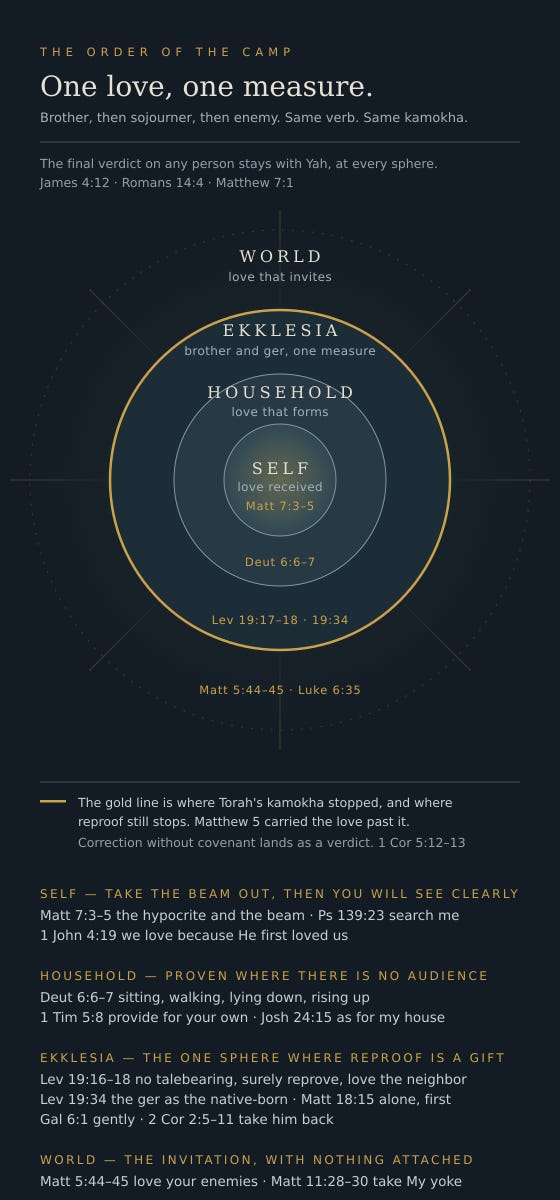
The four spheres
These are a way of asking where responsibility begins and how it travels. Scripture does not rank them. Life does.
Self. The innermost, and the one most people skip. We love because He first loved us. You cannot carry out what you have not taken in. The Psalmist asks Yah to search him and know his heart, which is the only self-examination that avoids both pride and despair, because someone else is doing the looking.
This is where the beam comes out. Note what the beam does and does not do. It does not disqualify a man from ever helping his brother. It disqualifies him from doing it while pretending his own condition is beside the point. We are hardest on the sins we have learned to call something else in ourselves.
Household. Where love is proven when nobody is watching. Deuteronomy 6 puts the words in the ordinary hours, sitting down, walking, lying down, rising up. No audience. This is where most people’s model breaks. It is easy to tell the truth in a small group on a Tuesday and hard to tell it at your own table on a Thursday. A man can be admired in the assembly and feared at home. Boldness in public buys nothing here.
Ekklesia. The ring where reproof is a gift, because everyone in it has entered the same covenant and agreed to the same standard. Speak the truth in love. Restore gently, watching yourself. Go to him alone first. And when he turns, take him back, because Paul warned a church that would not readmit a corrected brother that they would lose him to sorrow.
This is also the ring where the ger stands, and he is the test of whether the ring is real. Torah puts the man of different ancestry and lower standing under the same love with the same measure as the brother by birth. A congregation that has a full membership and a probationary one, an inner circle and a group that has to keep earning its place, has failed a commandment that is older than the church. Ask who in your assembly is loved kamokha and who is merely tolerated, and you will find the ger in your own camp.
And test the aim. Correction is not made faithful by being accurate. If you would be more satisfied by someone’s removal than by his return, whatever you are doing, Scripture does not call it reproof.
World. The invitation, with nothing attached. Do good and lend, expecting nothing back. Love your enemies. Come to Me, all who are weary, and take My yoke.
Yah does address the nations. He sent Jonah to Nineveh and Nineveh repented, and the prophets spoke to Babylon and Edom and Tyre. The gospel itself calls everyone everywhere to turn. So the world is not owed silence about repentance.
What the world is owed is the posture of a witness rather than the authority of a judge. Jonah was sent. He did not appoint himself, and the book ends with Yah rebuking him for wanting the verdict more than the repentance. We announce a kingdom we were carried into by mercy. We do not require people to live like disciples before they have become disciples, and winning an argument in public has never once fulfilled the commission.
Over all four spheres sits the one thing that belongs to nobody in the camp. There is one Lawgiver and Judge. The final verdict on any person’s standing before Yah is His, for the brother and the stranger alike.
The camp turned inside out
The Western church has reversed the polarity of the camp. It aims reproof outward at people who never entered the covenant, and extends mercy inward to people who did.
We will organize against a parade. We will not say a word to the brother whose greed is seated on the finance committee, and Paul put the greedy on the same list as the sexually immoral, in the same verse, in the church he was disciplining. We will hold a firm line on one sin and quietly stop counting divorce, because counting it would cost us attendance. We will tell the nations what Yah requires and excuse in ourselves the very thing we told them.
That is the camp inside out. Correction pointed at people outside our responsibility. Comfort extended to the people inside it. And the measure changes depending on which way we are facing, which is precisely what Yeshua said would come back on us.
This is not one denomination’s problem or one country’s or one century’s. It is the oldest available strategy: measure the outsider strictly so you never have to look closely at yourself.
The cost is not only hypocrisy. The cost is the fire. The world reads the camp from outside, and what it is supposed to see is a Presence at the center and a people who love each other in a way that cannot be explained. It watches how leaders use power, how families treat each other, whether the vulnerable are protected, whether wrongdoing gets confronted fairly, and whether a person who repents is ever allowed all the way back in. When we spend our witness on verdicts we were never given, we spend the only thing John 13:35 says the world is watching for.
What this does not mean
Getting the spheres in order does not mean the assembly stops telling the truth. Torah doubled the verb. Yeshua gave a procedure. Paul commanded restoration and, in grave cases, discipline. A community that has quietly agreed never to say a hard thing to anybody has not become loving. It has become a place where resentment, manipulation, and harm can grow without anyone naming them, and Leviticus 19:17 says you carry something for that silence.
It also does not mean the world matters less. The difference is authority and posture rather than worth. A stranger has agreed to nothing, so handing him a verdict he never asked for is not courage. What we owe him is the invitation, and a life that makes the invitation worth considering.
And reserving the final verdict for Yah does not end all human judgment. Courts decide cases. Communities protect people from harm. Assemblies discern teaching and conduct. Yeshua Himself said you will know them by their fruit. We can evaluate what a person does without claiming to know where he stands before God. We can hold a boundary without enjoying the exclusion. We can warn without taking the bench.
The road runs between. Reproof inside, gently, aimed at return, by people who have dealt with their own eyes first. Love outward, with nothing attached, carrying the message we were given. And the verdict left where it belongs.
Practice
Key Takeaways
Love keeps one measure, and Torah applied it twice. Ahav, kamokha, to the neighbor in Leviticus 19:18 and to the ger in 19:34. The ger lives inside the camp under the covenant, which means the command is about ancestry and standing rather than about the nations. Difference of origin does not reduce what a person in your assembly is owed.
Yeshua carried the measure past the last line Torah drew. Love your enemies, because the sun rises on the evil and the good. The root is Leviticus and the growth is Matthew 5, moving the same direction Torah was already moving.
Reproof and condemnation are different acts, and the beam decides which one you are performing. Yeshua assumes the speck comes out. He forbids the man with the beam from doing it, and He names the offense hypocrisy, a standard held over someone that the holder has exempted himself from.
The camp has been turned inside out, and the fire is what it costs. Correction aimed at the nations and comfort extended to the brother reverses the order. The world reads the camp from outside and looks for the Presence at the center.
The final verdict belongs to Yah. We discern conduct, protect the vulnerable, and hold boundaries. We do not know where any person stands before Him.
Discussion Questions
Picture the four spheres around your own life: yourself, your household, the assembly, and the world. Where are you most severe, and where are you most willing to make an excuse? Who is getting the version of you that you would not want used on you?
Who is the ger in your congregation, the person under the same covenant whose belonging keeps getting quietly questioned? What would loving him kamokha require that is not happening now?
Leviticus 19:17 forbids hating your brother in your heart and commands reproof in the same breath. Is there someone inside your covenant circle you have been silently carrying something about while telling yourself it is kindness? What has that silence done to your heart toward him?
When you feel the pull to correct someone, what outcome do you want underneath it: his return, your vindication, or his removal?
If someone outside the faith watched your household and your assembly for a month without hearing one word of your doctrine, what would they conclude about the One at the center?
Seven-Day Practice Rhythm
Day One: The beam. Alone with Yah, ask the Ruach to name one fault you are quick to see in others and slow to see in yourself. Write it down. Do not fix it yet. Let it be named.
Day Two: Read Leviticus 19 slowly. All of it, in one sitting. Watch it move between worship, wages, the deaf and the blind, the talebearer, the reproof, the neighbor, the ger. Notice that Torah refuses to separate holiness from how you treat the person in front of you.
Day Three: The household. One concrete act of love inside your own house that nobody outside it will ever know about. The closest ring is the hardest one.
Day Four: The direct word. Ask the Ruach whether you owe someone inside your covenant circle a private conversation. Before you go, ask whether you have heard the whole matter and whether you want him back. If the honest answer is that you would rather be rid of him, wait, and take that to Yah instead.
Day Five: The measure. For one day, turn every standard you apply to another person back on yourself. Use it to clean out the hypocrisy rather than to avoid the discernment.
Day Six: The stranger. Do something good for someone outside the covenant with nothing attached. No message, no follow-up, no expectation. Yah is kind to the ungrateful. Practice it.
Day Seven: Shabbat. Rest. Eat with people you love. Receive again the mercy you live on, and remember that you are neither the center of the camp nor the One on the throne.
Closing Blessing
May the God who set His Presence in the middle of a camp of tents, who told His people to reprove the brother beside them and love the sojourner in the next tent with the very same word, who sent His prophets to His own house before He ever sent one to Nineveh, who came Himself in Yeshua and carried that same love all the way out to the enemy, keep your spheres in their right order.
May you take the beam out first. May you love your household where no one can applaud you. May you have people close enough to tell you the truth and be humble enough to hear it back. May the one whose belonging gets questioned in your assembly be loved as you love yourself. May the one who repents be let all the way back in.
May you carry to the world the invitation you were handed and leave the verdict with the One it belongs to.
And may the fire at the center of your camp be visible from a long way off.
In the name of Yeshua, amen.