

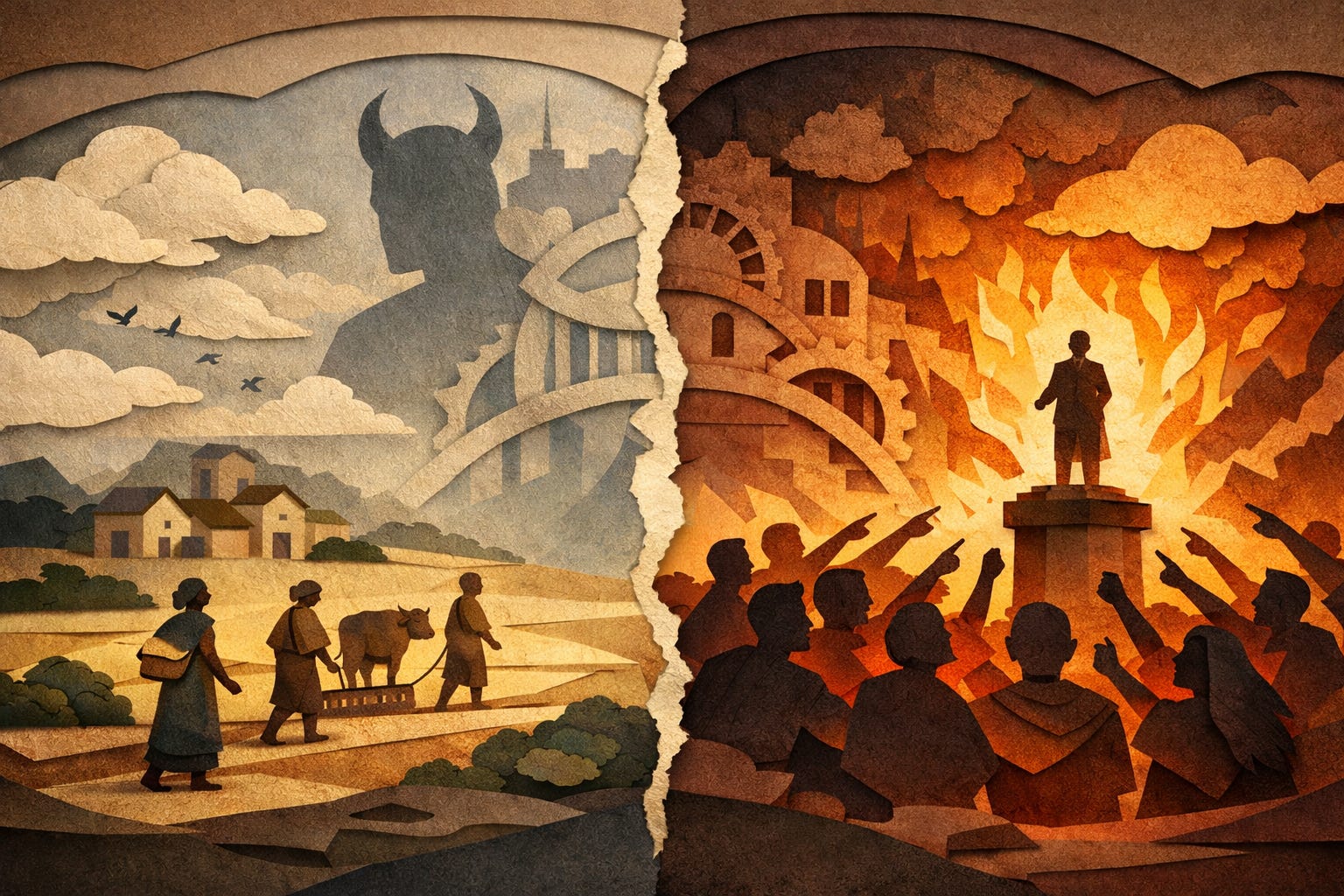
There is a war being fought over your life, and you are almost certainly losing it — not because you are weak, but because you don’t know it’s happening. You’ve been taught to look for evil in the wrong places. You look for monsters when you should be looking for systems. You look for villains when you should be looking for gravity.
This is how principalities work. And until you understand their playbook, you will keep fighting the wrong enemy — which is exactly what they need you to do.
The Invisible Architecture
Paul warned us plainly: “For our struggle is not against flesh and blood, but against the rulers, against the powers, against the worldly forces of this darkness, and against the spiritual forces of wickedness in the heavenly places”(Ephesians 6:12, TLV). Most people read that verse and nod. Almost nobody lives as though it’s true.
Principalities do not rule through overtly evil people. They rule through ordinary humans drawn in by self-interest, fear, and convenience. Over time, complicity binds these people together — not loyalty but mutual exposure. Everyone has enough skin in the game that the system holds through gravitational force. Nobody planned it. The principality organized it the way gravity organizes orbits: invisibly, naturally, inescapably.
Have you ever gone along with something — not because you believed in it, but because pushing back felt too costly?
The Two Tricks
The Devil has two tricks, and they work in sequence.
The first trick is convincing the world that he doesn’t exist. As long as people believe there is no spiritual force organizing human behavior toward destruction, they will explain the world’s darkness through comfortable categories: bad individuals, mental illness, political disagreements. The system stays invisible. The force stays unnamed.
But eventually, awareness rises. People begin to sense that what they’re witnessing is too coordinated, too self-replicating to be random. They sense the architecture. And this is when the Devil plays his second trick: he anthropomorphizes himself into a single human figure. Now people believe he exists — but in flesh and blood form. The first trick says there is no evil force. The second says the evil force is that person over there. Both accomplish the same thing: the principality itself is never named, never confronted, never dismantled.
The Empathy We Refuse
This playbook works because of a deeper lie we carry: most human beings do not believe they are capable of the most heinous forms of human behavior. We watch documentaries about atrocities and place ourselves with the resistors, the righteous. We would never.
This is not empathy. This is its opposite. German citizens who looked away while neighbors were loaded onto trains didn’t think they were capable of it either. Plantation owners went to church on Sunday and prayed sincerely. The people who enabled every system of exploitation in history were not sociopaths. They were people who had placed evil outside the boundary of their own potential.
True empathy begins with a genuine reckoning: there go I but for the grace of God. You are not the author of your own goodness. You are not immune to the worst of what humans have done. When you truly understand this, you recognize that your behavior is never entirely your own. You are always being animated by something — a principality pulling you toward self-protection and complicity, or the Ruach pulling you toward vulnerability and covenant faithfulness. There is no neutral ground.
“The heart is deceitful above all things, and incurably sick — who can know it?” (Jeremiah 17:9, TLV)
The Principality Made Flesh
Once you see the playbook, you see it everywhere. Pharaoh, Leopold II, Hitler, Mussolini, Bin Laden, Madoff — every one became the face of a system that survived them. The face was removed. The force continued. Every time.
Weinstein, Epstein, and Diddy show it most nakedly. None operated alone. Each was surrounded by agents, lawyers, executives, media, and fans who knew — or chose not to. The networks held not through loyalty but mutual exposure: everyone had enough to lose that silence was rational. When each figure fell, the public called it justice. But the principality had simply sacrificed a pawn. The rooms are still there. The pipelines are still open. Only the face changed.
Trump is the most instructive case because the anthropomorphization is working in real time — on both sides. He didn’t create the forces he represents: white Christian nationalism, the fusion of patriotic mythology with theological authority, the economics of resentment, the deep American habit of mistaking wealth for blessing and power for anointing. These are woven into the founding contradictions of a nation that proclaimed liberty while enslaving millions and built churches on stolen land and called it the Kingdom of God.
What Trump did is give that system a personality. And in doing so, he accomplished both tricks simultaneously. For his supporters, he is the solution — and loyalty to him becomes loyalty to the cause, creating a complicity network of politicians who know better, pastors who trade prophetic witness for access, and citizens who’ve invested so much identity that questioning him means confronting their own complicity. For his opponents, he is the problem — remove him and the nation heals. Both responses serve the principality. One half worships the figure, the other half wars against the figure, and nobody names the spiritual force that produced him and will produce the next one when he’s gone.
And here the lack of empathy is most costly. His followers are not monsters — they are ordinary people caught in a principality’s gravitational pull that speaks to real fears and losses. His opponents are not righteous — they are caught in a different principality that offers moral superiority as a substitute for genuine solidarity. Neither side can see the principality operating through them because both believe they are incapable of being manipulated.
“Why do you look at the speck in your brother’s eye, but do not notice the beam in your own eye?” (Matthew 7:3, TLV)
What would change if you genuinely believed the people on the “other side” are caught in the same kind of gravitational pull you are?
The Kingdom Alternative
The principalities tried their playbook on Yeshua: concentrate the threat into one body, eliminate the body. The cross looked like their masterstroke. But the resurrection shattered the mechanism. And at Pentecost, God did what principalities never do — instead of re-concentrating power into another single figure, the Ruach distributed the incarnation across all who believe and are willing (Acts 1:8, TLV).
The principality concentrates power into one to control the many. God distributes His presence into the many to liberate all. The principality’s incarnation is fragile — kill the host and it starts over, leaving only the ghost of ideology searching for new flesh. God’s incarnation multiplies without end and cannot be decapitated.
Under the principality, you make decisions to protect yourself from being exposed. In the Kingdom, you make decisions to expose yourself in faith — knowing that vulnerability is the very mechanism through which God’s protection operates.
The temptation narrative reveals this contrast at its origin point (Matthew 4:1-11, TLV). Each of the Devil’s three offers is the principality’s recruitment pitch — an invitation to adopt the logic of self-protection over self-exposure.
“Turn stones to bread” (Matthew 4:3) — use your power to insulate yourself from need. Never let your lack be visible. Never be dependent. This is the principality’s first rule: never be exposed. Yeshua refused, choosing to remain vulnerable and dependent on the Father’s provision rather than self-sufficient.
“Throw yourself from the temple” (Matthew 4:6) — force God to protect you publicly, on your terms, with spectacle. This is the principality’s version of faith: engineer a scenario where you appear to take a risk but have already guaranteed the outcome. Yeshua refused manufactured exposure that was really just concealed self-protection.
“Take all the kingdoms” (Matthew 4:9) — accept the concentrated incarnation model. Become the single figure who rules from the top. Skip the cross, skip the distribution, skip Pentecost. This is the principality offering Yeshua its own strategy. He refused because the Kingdom doesn’t concentrate power into one — it distributes presence into all.
Every temptation was an invitation to make decisions the way principalities make decisions. Yeshua refused all three, choosing radical dependence, genuine vulnerability, and distributed presence over concentrated power. The cross became the ultimate expression of that refusal — maximum exposure, zero self-protection — and the resurrection proved the Kingdom’s logic was stronger than the principality’s all along.
But here is where the church must confront itself honestly. Is our worship centered on the anthropomorphization of Yah in Yeshua — on the figure as the object of devotion — or is it centered in gratefulness and love for Yah for what He accomplished through Yeshua to give us the Ruach? The difference matters eternally. Yeshua himself said it was better that he leave (John 16:7, TLV). He said we would do greater things (John 14:12, TLV). His understanding of his own mission was transitional, not terminal — the means by which Yah’s presence moved from concentrated in one to distributed in all.
When the church sings “King Jesus is going to work it out” and then sits down and waits, it has adopted the principality’s model and applied it to God. One figure holds the power. The masses worship and remain passive. But Yeshua delegated his authority to his ekklesia and sent the Ruach as the power source. We are his loyal subjects, empowered to act on his behalf until he returns. The highest honor we give the returning King is not a louder song — it is a functioning kingdom. The Ruach active. The ekklesia moving. Yah’s will being done on earth as it is in heaven.
“Do not be conformed to this world but be transformed by the renewing of your mind, so that you may discern what is the will of God — what is good and acceptable and perfect” (Romans 12:2, TLV).
The principalities are not afraid of your opinions, your outrage, or your vote. They are afraid of communities who have stopped falling for the two tricks — who refuse to pretend the forces don’t exist, and who refuse to reduce those forces to a human face. They are afraid of people who have surrendered the lie that they are incapable of evil and have therefore become capable of genuine empathy. They are afraid of people who expose themselves in faith rather than protect themselves in fear.
They are afraid of the Kingdom.
What would it look like for your community to stop fighting faces and start naming principalities? What would you have to give up? What would you have to confess?
“For I am convinced that neither death nor life, nor angels nor principalities, nor things present nor things to come, nor powers, nor height nor depth, nor any other created thing will be able to separate us from the love of God that is in Messiah Yeshua our Lord” (Romans 8:38-39, TLV).