

This is part two of a four -part series expanding on The Principality Playbook: How Evil Operates and Why We Keep Falling for It. If you haven’t read the original, start there. Part 1 exposed how principalities get inside ordinary people — stage by stage, decision by decision. Part 2 asks the harder question: what happens when the system gets caught? How does a principality survive its own exposure?
The Most Dangerous Counterfeit
There is a principle that governs how evil operates in the cosmological order, and it is this: the lie that is most dangerous is that which is closest to the truth.
A principality does not create. It counterfeits. It does not invent new spiritual mechanisms. It bastardizes existing ones — mechanisms that God designed, that function within the legitimate architecture of the spiritual realm, that produce real results when used as intended. The counterfeit works not because it is clever but because it is running on legitimate spiritual infrastructure. It feels right. It produces genuine emotional and even spiritual satisfaction. And that is precisely what makes it almost impossible to detect from the inside.
Nowhere is this more visible than in what a principality does with a scapegoat.
What principality or system in your life produces results that feel legitimate — that feel like justice, like progress, like righteousness — but never quite resolve the underlying problem?
God’s Scapegoat
On Yom Kippur, YHWH gave Israel a mechanism for dealing with sin that had become too diffuse, too embedded in the fabric of communal life to be addressed individually. You could not locate it in one person because it was everywhere.
Two goats were selected. One was slaughtered as a sin offering. The other — the Azazel goat — had the sins of the entire nation confessed over it by the high priest, who laid both hands on the animal’s head and transferred collective guilt onto a single visible body. Then the goat was driven into the wilderness, carrying what was invisible into a place of removal.
“Then Aaron is to lay both his hands on the head of the live goat and confess over it all the iniquities of Bnei-Yisrael and all their transgressions, all their sins. He is to put them on the head of the goat, and send it away into the wilderness”(Leviticus 16:21, TLV).
This was not primitive ritual. This was divine technology. God understood that communal sin operates systemically — it embeds itself in culture, economics, relationships, and daily decisions until no single person can be identified as the source. So He provided a mechanism: concentrate the invisible into the visible, place it on a single body, remove it. The community is genuinely restored. The sin is genuinely dealt with.
Remember that. The mechanism is real. It works. God designed it to work.
Why would God design a system that required transferring collective guilt onto an innocent body? What does that reveal about how sin actually operates — not individually but communally?
The Principality’s Counterfeit
Now watch what a principality does with this.
A principality operates through networks of ordinary people — the stages we explored in Part 1. Thousands orbit the system. The evil is distributed, diffuse, embedded in culture and economics and silence and complicity. But eventually the system gets exposed. People start seeing it. Journalists investigate. Victims speak. And this is the principality’s most dangerous moment — because if people trace the evil back to the system itself, the spiritual architecture gets dismantled.
So the principality runs its own Yom Kippur.
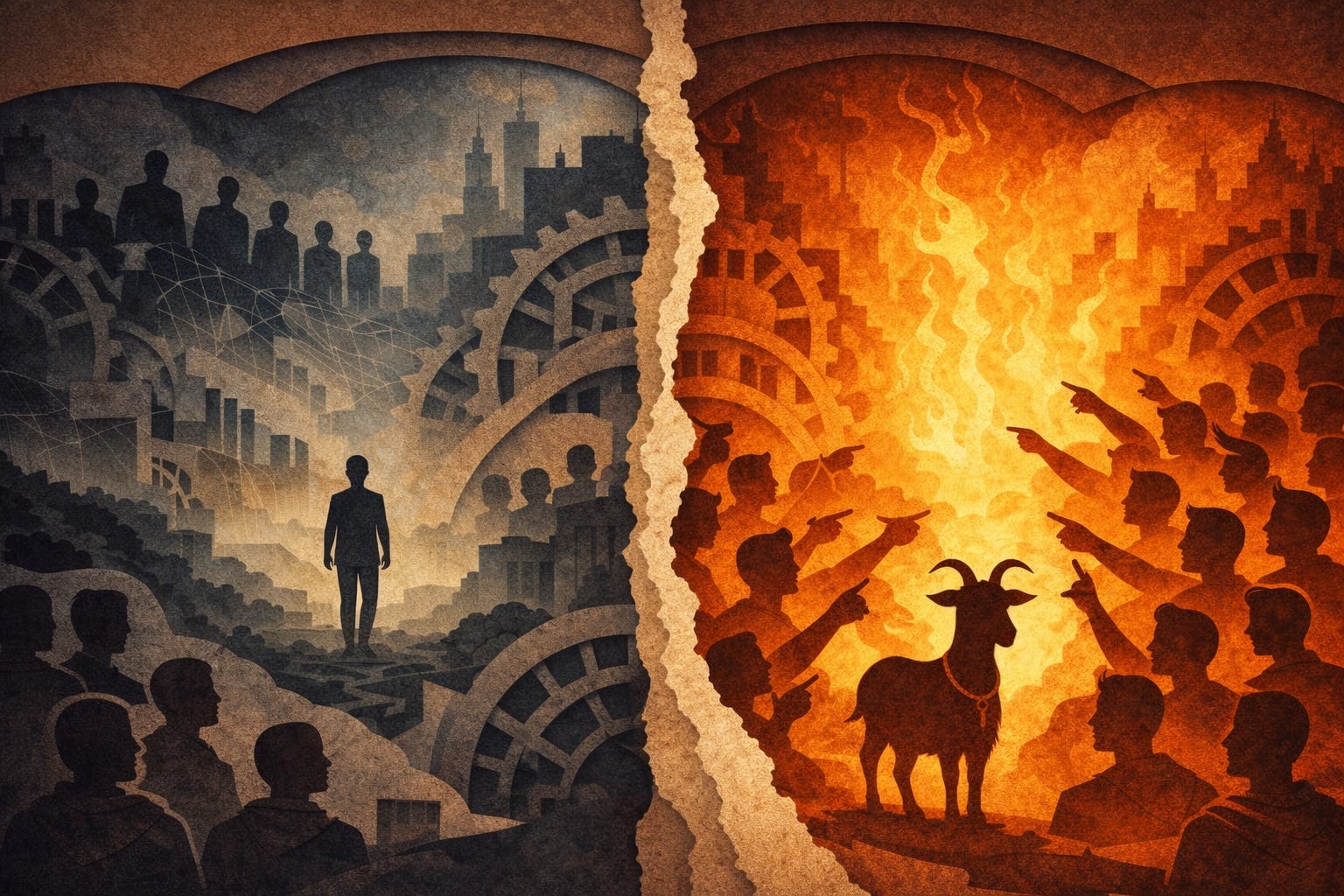
It concentrates all visible blame onto one human figure — the person who became the face of the system. All the outrage, all the guilt, all the moral energy flows toward that person. They become the Azazel goat. They are prosecuted, canceled, removed, driven into the wilderness of public condemnation. And everyone exhales. Justice was done. The sin was dealt with.
Except it was not. Because the principality is not that person. The principality is the architecture — the network of complicity, the culture of silence, the economic incentives, the theological justifications. All of that remains completely intact. The scapegoat carried away the visibility of the sin, not the sin itself.
This is a counterfeit Yom Kippur. It mimics God’s mechanism — concentrate the invisible into the visible and remove it — but inverts the purpose. God’s scapegoat was designed to genuinely remove sin from the community. The principality’s scapegoat is designed to protect sin by making everyone believe it has already been dealt with. And because the counterfeit is running on legitimate spiritual architecture, it produces genuine catharsis. Real relief. Actual satisfaction. That is why you cannot see through it. The 90% that is real conceals the 10% that is lethal.
Pharaoh became the face of imperial slavery — but Israel spent forty years trying to get Egypt out of themselves. Leopold became the face of colonial extraction — but the system continued under different management across Africa for a century. Hitler became the face of fascism — but the principality migrated, adapted, found new hosts. Weinstein became the face of entertainment industry predation — but agents still send talent into dangerous rooms, and the pipeline remains open. Epstein became the face of elite exploitation — but the client list has never been fully exposed. In every case: the face was removed, the system exhaled, and the principality reconstituted within months.
But the counterfeit does something worse than merely protect the system. It advances it.
The visible figure does not just represent the principality — they systematize it. They embed the principality’s agenda into law, policy, culture, institutional norms, and economic structures. They move the needle. And when they are removed as scapegoat, all of that infrastructure remains. The successor appears more benevolent — because they are not actively pushing the needle further. But they do not push it back. They govern from the new baseline. And the public, exhausted from the outrage of the last cycle, accepts that baseline as normal. The energy that might have been used to dismantle what the figure built was consumed entirely by the spectacle of the figure’s removal.
This is the ratchet. Each scapegoat cycle does not just protect the principality. It locks in gains. The needle moves forward and never returns. The next figure inherits a world that has already been reshaped, and the public cannot even remember where the line used to be.
The question is never “did the right person get punished?” The question is: what was systematized while they were in power that no one is dismantling now that they are gone? And the harder question: have you already adapted to the new baseline without realizing the principality moved you there?
Think about a public figure whose fall felt like justice to you. What did they build or systematize that is still operating? What baseline shifted while everyone was watching the person instead of the architecture?
The Scapegoat Who Broke the Machine
The powers of Yeshua’s day — Rome and the religious establishment working in concert — used the exact same mechanism. Concentrate the threat onto one body. Remove the body. The system survives.
“This Man, delivered up by the predetermined plan and foreknowledge of God, you nailed up and put to death by the hands of lawless men” (Acts 2:23, TLV).
The cross was supposed to be the principality’s greatest victory — the ultimate scapegoating. Place the blame on one man. Let the crowd participate. Let the religious leaders feel righteous. Let Rome feel secure. Drive this goat into the wilderness of death. Everyone exhales.
But the resurrection broke the machine. You cannot scapegoat someone who comes back. The cross exposed the mechanism itself — it revealed that the powers had just performed the counterfeit scapegoat ritual on the only truly innocent person who ever lived. Which meant the system was guilty, not the scapegoat. The entire architecture of religious and political complicity was laid bare.
This is why the earliest proclamation was not “Yeshua died for your personal sins so you can go to heaven.” It was: you killed him, God raised him, and everything you thought was righteous power is now exposed as murderous complicity. The resurrection did not just defeat death. It rendered the principality’s primary survival mechanism permanently unreliable.
How does the resurrection reframe your understanding of justice? If the principality’s scapegoat mechanism is designed to make you feel like the problem is solved, what does the resurrection reveal about the problems you’ve stopped examining?
Two Concealment Strategies
There is another parallel running beneath all of this.
Yeshua concealed his identity throughout his ministry. Every time he healed someone, he said “tell no one.” Mark’s Gospel is built on this — the Messianic Secret. But his concealment was strategic and temporary. It served revelation. Everything he did moved toward the moment of full disclosure. The cross and resurrection were the unveiling. His “not yet” pointed toward a chosen moment when everything hidden would be made known.
The principality also conceals itself. But its concealment is permanent and desperate. It never wants to be seen. And when exposure threatens, it sacrifices the human host — outing a person to protect a system. The scapegoat absorbs not just blame but visibility. Everyone looks at the person. Nobody looks at the architecture.
The principality is essentially running the same “not yet” — but for survival, not mission. And it knows it cannot hold. Paul said the mystery of lawlessness is already at work but is being restrained until the proper time (2 Thessalonians 2:7). There is a divine timeline for the exposure of evil, just as there was a divine timeline for the exposure of Yeshua’s identity. Every scapegoat the principality throws to the crowd is buying time on a clock it did not set and cannot stop.
What if concealment itself — in your theology, your institutions, your personal life — is the primary indicator that a principality is at work? What are you protecting from exposure, and who benefits from that protection?
The Season of Unveiling
We are living in an unprecedented moment.
For centuries, the principality’s concealment strategy relied on gatekeeping. It relied on the fact that most believers would never learn Aramaic, never read Second Temple literature, never encounter the historical Yeshua behind the Hellenized Christ that Greek translation and Roman imperial theology constructed. Language, culture, and time created layers of insulation — each one looking like normal theological development, normal translation choices, normal cultural adaptation. None of it looked like a cover-up. All of it functioned as one.
And now those layers are collapsing. Aramaic scholarship that was locked in academic institutions is accessible to anyone with an internet connection. The Dead Sea Scrolls are digitized. Hebrew and Aramaic lexicons that required seminary training are free. First-century cultural context is in podcasts, newsletters, and open-access journals. The principality cannot gatekeep what is available to everyone. It cannot maintain evacuation theology when people can read for themselves that Yeshua never once told anyone to focus on leaving earth. It cannot preserve the domesticated gospel when the original language reveals how radical the proclamation actually was.
Daniel was told to seal the book until the time of the end, when knowledge would increase (Daniel 12:4). What if the information age is not merely a technological development? What if it is the mechanism by which the “tell no one” season transitions into the “shout it from the rooftops” season? What if the same God who said “seal the book” ensured that the tools would exist to unseal it?
This is why work like this matters. We are not engaged in academic curiosity. We are participating in a divinely timed unveiling — recovering what principalities spent centuries concealing through the very tools those principalities can no longer control.
The concealment is failing. The question is whether we will participate in the exposure or continue to exhale every time the principality sacrifices another face.
Where We Go From Here
Now you know how the principality survives — not through strength but through sacrifice. It throws a body to the crowd and reconstitutes in the dark. But the resurrection broke that machine, and the information age is collapsing the concealment infrastructure that kept it hidden.
In Part 3, we confront the Kingdom’s counter-strategy: how the resurrection inverts the principality’s logic, why Yeshua refused concentration of power, and what it means for the ekklesia to operate as distributed presence rather than centralized authority.
“For nothing is hidden that will not become evident, nor secret that will not be known and come to light” (Luke 8:17, TLV)