

Scripture
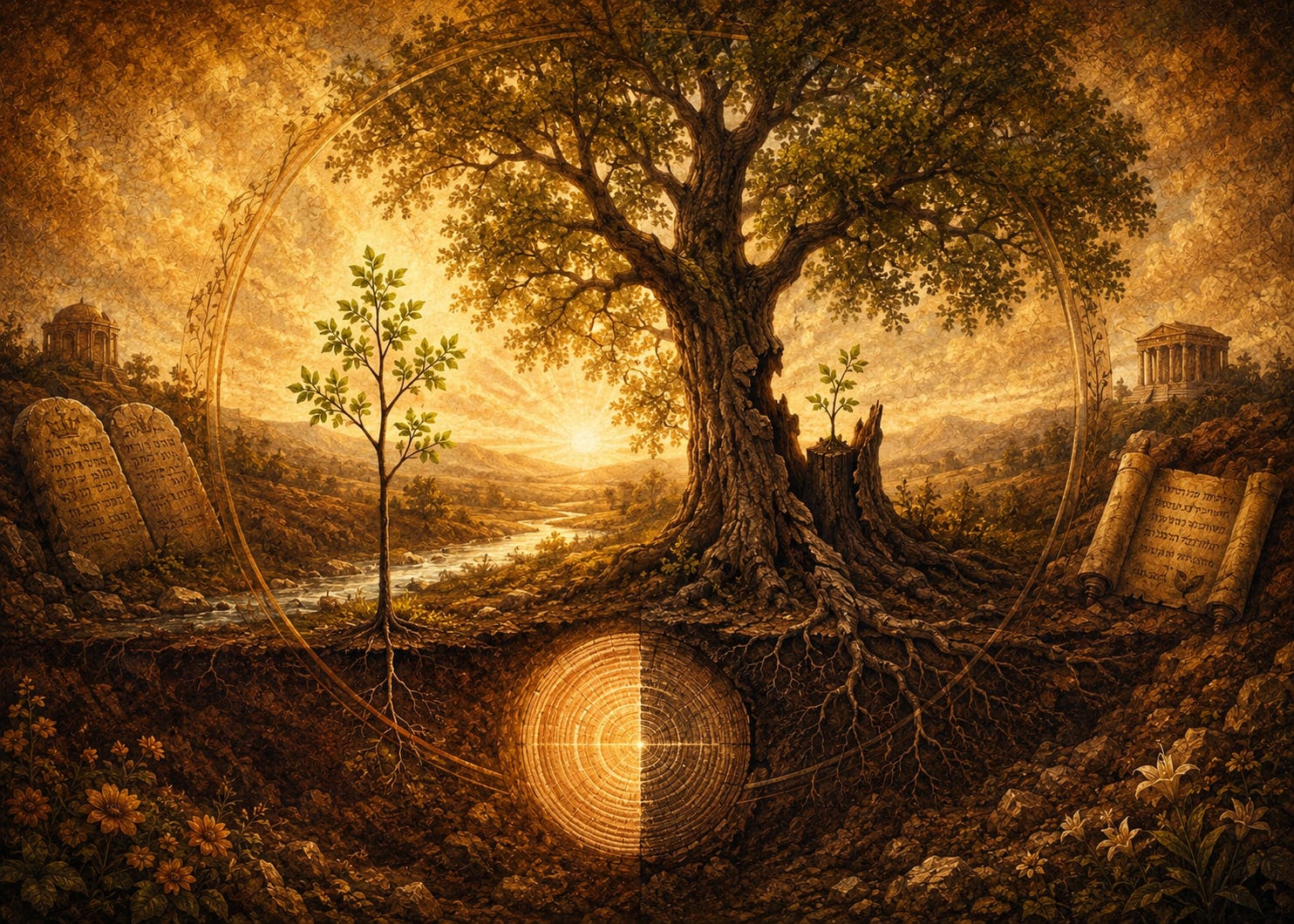
There is a street where old trees and young trees live side by side. Some have stood for more than a hundred years. Their trunks are thick, their root systems deep, their canopies wide enough to shade three houses at once. And they are the ones the storms find. Every few years lightning or wind takes another, and the crews come with their saws, and where a giant stood there is suddenly sky. Then a sapling goes into the ground, thin as a broomstick, and the street begins again.
We look at that street and we think we see two different stories. The sapling is growing. The oak is dying. But that is one story wearing two faces. The sapling is dying every day at the cellular level, shedding what cannot serve it, pruning itself from the inside so that growth can continue. And the oak, right up until the day it falls, is still pushing new wood, still leafing out each spring, still growing. Both trees are doing both things at all times. We simply choose which half of the story to see.
Scripture refuses to let us make that choice. It holds death and renewal together in a single hand, at every age, in every season.
Sha’ul writes to the believers in Rome: do not be conformed to this world, but be transformed by the renewing of your mind (Romans 12:2). The renewing of the mind. Present tense. Ongoing. He does not say your mind was renewed once at the moment you believed. He says the renewal is a continuing work, available for as long as you have a mind to renew.
The psalmist gives us the tree itself: he will be like a planted tree over streams of water, producing its fruit during its season. Its leaf never droops (Psalm 1:3). Notice what this tree is. It is a tree in seasons. Fruit comes during its season, which means there are seasons when the fruit is absent, when the branches look bare, when everything visible says decline. The leaf does not wither because the root is in the water, and the water does not care what season it is.
Yeshua takes it further: every branch in Me that does not bear fruit, He takes away; and every branch that bears fruit, He prunes so that it may bear more fruit (John 15:1–2). Read that again slowly. The branch that is bearing fruit is the one that gets cut. Pruning is what the Gardener does to the healthy branch. The cutting is care. The loss is the mechanism of the increase.
Sha’ul tells the Colossians to put to death what is earthly in you and in the same breath to put on the new self, being renewed in knowledge according to the image of its Creator (Colossians 3:5–10). One act with two motions. The dying and the dressing happen together.
And then he gives us the sentence this entire lesson stands on: therefore we do not lose heart. Though our outward man is decaying, yet our inward man is renewed day by day (2 Corinthians 4:16). Decaying and renewed. Both verbs. Same person. Same day. Sha’ul does not resolve the tension. He plants his flag inside it and says this is where we live.
The street with the old trees and the young trees is not showing us two stories. It is showing us the one story we spend most of our lives refusing to read whole.
Context
Every culture builds a story about the arc of a life, and ours has built a simple one: youth is for growing, old age is for declining, and somewhere in the middle you cross an invisible line where one becomes the other. The story feels true because it matches what the eye can see. The sapling gets taller every year. The oak drops limbs. Case closed.
But the eye is a poor forensic witness. Inside the young body, death is constant and enormous. Cells die by the billions daily so that tissue can renew. The immune system hunts down and kills cells that have begun to mutate, executing them before they can organize into cancer. Neural connections that go unused are cut away in a process scientists literally call pruning, and it is precisely this cutting that makes a child’s mind sharp. A young person who never experienced cellular death would not be immortal. They would be dead within days. The growth we admire in the young is built on a foundation of relentless, invisible dying.
Now turn the lens the other way. Inside the aging body, renewal is still running. The science of neuroplasticity has dismantled the old belief that the brain finishes forming in youth and then only erodes. The brain remains capable of forming new connections, learning new patterns, and reorganizing itself around new understanding into the eighth and ninth decades of life. The capacity diminishes where disease intrudes, and we should be honest about that. But the common experience of aging as pure decline is not primarily a biological verdict. It is often a story the person has accepted, a surrender dressed up as realism. Renewal did not leave them. They stopped reaching for it, because everyone around them agreed it was no longer theirs to claim.
So here is the situation as it actually stands. The young are dying and do not know it, because the dying is drowned out by visible growth. The old are renewing and do not believe it, because the renewal is drowned out by visible decay. Both are living half-aware. Both have accepted a lie about what is happening inside them, and the two lies are mirror images of each other.
This matters spiritually because the lie determines the practice. The young person who believes they are only growing sees no reason to prune. Why release anything, why turn from anything, why die to anything, when life is nothing but addition? So the attachments accumulate, the compromises take root, and the branches that will never bear fruit grow thick and heavy. Meanwhile the older person who believes they are only declining sees no reason to reach. Why learn, why transform, why let the Ruach renew the mind, when the story says the renewing is finished? So the mind that could still be changed sits unchanged, waiting for an ending.
The trees make no such mistake. The sapling prunes without being told. The old oak pushes new growth in its final spring. Neither one consults a story about what its season permits. They simply do both things at once, all the way to the end, because both things are what living is.
The first-century world Yeshua spoke into understood this better than we do. His hearers were agricultural people who watched vineyards worked by hand. When he said the Gardener prunes every fruitful branch, no one in the crowd heard a threat. They heard ordinary husbandry, the thing done to a vine you love. The scandal of John 15 for a modern reader is that loss and flourishing are the same operation. For his original hearers, that was simply Tuesday in the vineyard.
We have lost that instinct, and the loss costs us at both ends of life. It sends the young into decades of unpruned accumulation, and it sends the old into premature spiritual retirement. The lesson of the trees, and the lesson of the texts, is that there is no age at which you are doing only one thing. You are always dying. You are always being renewed. The only question is whether you will participate in both knowingly, or be dragged through both blind.
Covenant
Here is where the observation becomes an invitation, because Yah does not hand us biology as trivia. He hands it to us as testimony. The heavens declare His glory, and so does the quiet cellular death protecting a twenty-year-old from cancer, and so does the ninety-year-old brain still capable of forming a new thought. The creation is preaching. The question is whether we will let it preach to us.
The covenant Yah offers is not a rescue from the rhythm of dying and renewal. It is entry into that rhythm as a willing participant. This is what Jeremiah saw when he described the new covenant: I will put My Torah within them. Yes, I will write it on their heart (Jeremiah 31:33). Writing on a heart is not a single stroke. It is engraving, and engraving removes material. Something is cut away so that something can be inscribed. The covenant promise itself has the shape of pruning and growth in one motion.
This is also what teshuvah is, understood rightly. We tend to speak of repentance as an event, a moment of crisis when a person turns. But turning is a discipline before it is a crisis. The one who practices teshuvah in small, continual acts, releasing the belief that flattered them, the grievance that fed them, the identity that no longer told the truth about who they were becoming, that person is doing spiritually what their own cells have been doing all along. They are dying on purpose, in the right places, so that life can continue in the right places. Sha’ul calls this being transformed by the renewing of your mind, and he issues the command with no age limit attached, because the Ruach does not check your birth year before beginning work.
Now consider what this covenant rhythm does to the two lies we named. The young believer who practices pruning early is not being morbid. They are refusing the lie that life is pure addition. Every attachment released, every falsehood turned from, every small death chosen in alignment with the Ruach is a rehearsal, and rehearsal is exactly the right word. They are learning the movement in low light so they can perform it when the stage darkens. When physical fragility eventually arrives, and it arrives for everyone the storm does not take first, they will not meet death as a stranger breaking down the door. They will recognize it as the outward form of a rhythm they have kept for decades. The panic that seizes so many at the end is not really fear of death. It is the terror of being asked to do, all at once and without practice, what they were invited to do gradually across a lifetime.
And the older believer who practices renewal late is refusing the mirror lie. When they take up a new understanding at eighty, when they let a long-held certainty be corrected, when they allow the Ruach to renew a mind the world has already filed under finished, they are bearing witness that the covenant has no retirement clause. They will still yield fruit in old age. They will be full of sap and freshness (Psalm 92:14–15). The psalmist wrote that about the righteous planted in the house of Yahweh, and he wrote it as a declaration that Yahweh is upright. An old tree still bearing fruit is not an anomaly. It is evidence about the Gardener.
So the covenant collapses the false timeline. There is no season for growing and a later season for dying. There is one continuous season in which both are always offered, and the covenant-keeper is simply the one who says yes to both. Yes to the pruning, which is the Gardener’s care for a fruitful branch. Yes to the renewal, which is the Ruach’s ongoing work in any mind still willing to be changed. The sapling and the oak keep the same covenant with the soil. The young believer and the old one keep the same covenant with Yah.
And when the lightning comes, whenever it comes, it does not find an unprepared tree. It finds one that has been dying and living in the same motion all along, rooted by the water, leaf still green.
Practice
There was a man in his late eighties who decided to learn to read Hebrew. His children thought it was a sweet eccentricity. His doctor thought it was good for his brain. But he wasn’t doing it for either reason. He had spent sixty years reading Scripture through other people’s translations, and he wanted, before the end, to see the words with his own eyes. He studied slowly. Some mornings the letters swam. And two years in, sitting with the opening lines of Bereshit, he wept, because he was seeing something new at eighty-seven, and the seeing itself was the proof that the story about him being finished had been a lie.
That same year, a woman in her twenties in the same congregation walked away from a career she had spent a decade building. Everyone called it a waste. What they could not see was that the career had become a branch growing thick and heavy in the wrong direction, feeding an identity that was slowly choking the person Yah was forming. She cut it. It felt like death because it was one. And the fruit that came afterward could not have grown on the old wood.
An old man growing. A young woman pruning. Each doing the work our culture assigns to the other’s season, and each more alive for it. That is the practice: both motions, at every age, held together on purpose.
Each day this week carries two small acts. One pruning, one renewal. Neither needs to be dramatic. The work is quiet.
Three Takeaways
You are always doing both. At every age, in every season, you are dying and being renewed at the same time. The young are dying invisibly beneath their growth. The old are growing invisibly beneath their decline. Spiritual maturity is seeing both halves of your own story at once.
Pruning is the Gardener’s care for a fruitful branch. The cutting in John 15 is not judgment on failure. It is what is done to the branch that is bearing fruit, so it can bear more. Chosen loss, in alignment with the Ruach, is a form of growth.
The covenant has no retirement clause. The command to be transformed by the renewing of your mind arrives with no age limit. The righteous still bear fruit in old age, and that fruit is testimony about the Gardener, not the tree.
Three Questions
Which lie have you been living, the lie of pure growth or the lie of pure decline, and what has it cost you in practice?
What is one branch in your life that is growing but should not be? What would it look like to let the Gardener cut it this month?
If physical fragility arrived for you next year, what spiritual muscle would you wish you had built? What is stopping you from building it now?
Seven-Day Practice
Day 1 — Name the season you believe you are in. Write down, honestly, which story you have been living: only growing, or only declining. Ask the Ruach to show you the half you have been refusing to see.
Day 2 — Prune a belief. Identify one assumption about yourself that no longer tells the truth, something like “this is just who I am” or “it is too late for me to change.” Release it in prayer, by name.
Day 3 — Reach for new growth. Learn one thing you have been telling yourself you are past learning, or start one thing you have deferred. Let the mind be renewed in a concrete, visible way.
Day 4 — Prune an attachment. Find one thing you are holding that is taking nutrients from what should be growing: a grievance, a habit, a possession, an old identity. Cut it consciously, the way the Gardener cuts a fruitful branch, as care rather than punishment.
Day 5 — Renew a relationship. Push new growth toward another person. A conversation you have postponed, a word of blessing, a repair. Old wood can still leaf out.
Day 6 — Rehearse the ending. Spend fifteen unhurried minutes considering your own mortality without flinching and without despair. Not as a morbid exercise but as the sapling’s honesty: I am dying now, and I am growing now, and both are true. Pray Psalm 90:12, asking Yah to teach you to number your days.
Day 7 — Rest in the rhythm. Do neither work. Sit in Shabbat rest with the knowledge that the dying and the renewing continue in you even while you rest, because the rhythm was never yours to sustain. It is the Gardener’s.
Closing Blessing
May you stand like the tree planted by streams of water, rooted where the seasons cannot reach the source. May you learn to die daily without fear and to grow daily without pride. May the Gardener’s pruning find you fruitful, and may His renewal find you willing, whether you are the sapling just entering the ground or the oak in its hundredth spring. And when the storm comes, whenever it comes, may it find you green.