

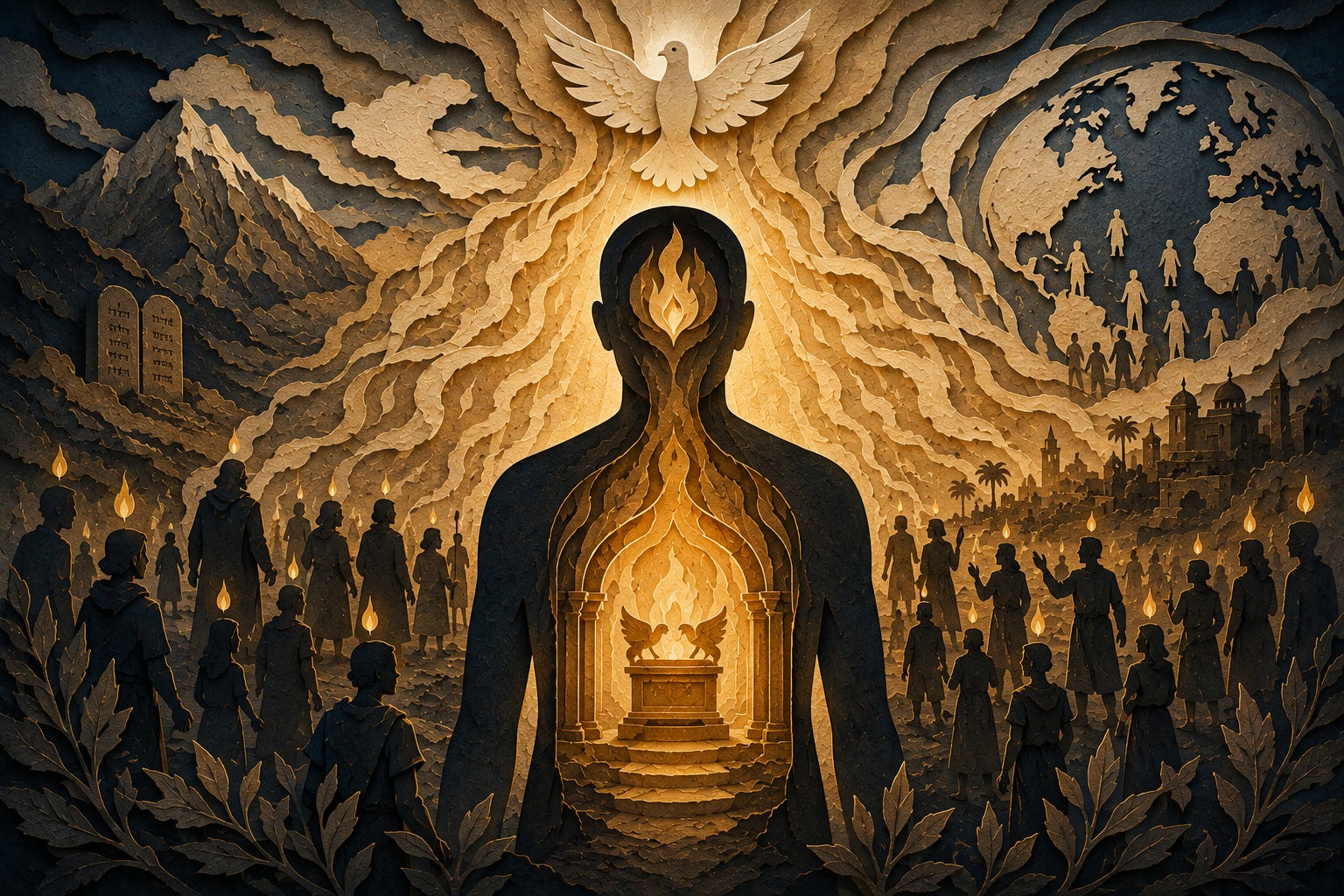
Today the Christian world will celebrate Pentecost. Very few will celebrate Shavuot. They are the same day.
Wind. Fire. A great sound from heaven. The Word going out to people from every nation, each one hearing it in their own language. The first time this happened, it happened on a mountain in the wilderness, roughly fourteen centuries before Acts 2. Same calendar day. Same divine signature. Same Author. The Shavuot of Sinai put the Torah of YHWH on stone. The Shavuot of Acts 2 put it on the human heart.
The Ruach Hakodesh is not an “it.” He is a Person, sent by the Father and by the Son, with a voice, a will, and a name. Most Western Christians have inherited language that turns Him into a thing. A force. An influence. A feeling. We sing about Him, invoke Him, ask to be filled with Him, and we have very little vocabulary for what He actually does, where He came from, or why He arrived on this specific Hebrew feast day.
This is the door we are walking through today.
Here is the Scripture section, formatted clean for Substack. Heading set with H2 markdown, Scripture in a block quote, TLV link on Bible Gateway right under the quote.
Scripture
Fifty days after the resurrection of Yeshua, His disciples were gathered in Jerusalem as He had instructed them. The day was Shavuot, one of the three pilgrimage feasts of the Hebrew calendar and the same feast that commemorates the giving of the Torah at Sinai. The city was packed with pilgrims from every nation under heaven who had traveled in for the feast. Luke tells us what happened next.
When the day of Shavuot had come, they were all together in one place. Suddenly there came from heaven a sound like a mighty rushing wind, and it filled the whole house where they were sitting. And tongues like fire spreading out appeared to them and settled on each one of them. They were all filled with the Ruach ha-Kodesh and began to speak in other tongues as the Ruach enabled them to speak out.
Sit with that for a moment before moving on. Every line is doing structural work that the rest of this lesson will open. Wind. Fire. Sound from heaven. The Word going out in many languages on the day of Shavuot, in the city of Jerusalem, to representatives from every nation. None of that is decoration. It is signature.
Here is the full updated Context section, ready to paste.
Context
The Calendar
The word “Pentecost” is simply Greek for “fiftieth.” Pentecost is not the name of a feast. It is a count. The feast itself is Shavuot, and it falls fifty days after the wave offering of firstfruits that takes place during the week of Pesach.
The counting starts on the day of the wave offering of the firstfruits of barley, the day after the Shabbat that falls within the week of Unleavened Bread. From that day, the covenant people count seven complete weeks, and on the day after the seventh Shabbat, they bring a new offering of firstfruits of wheat. That day is Shavuot. The Greek-speaking world called it Pentecost because it was the fiftieth day of the count.
Three things matter about this feast in the Hebrew calendar.
It is one of the three pilgrimage feasts of the Hebrew calendar, alongside Pesach and Sukkot. Every able-bodied male in Israel was commanded to come to Jerusalem for it (Deuteronomy 16:16). That is why Jerusalem was packed in Acts 2 with Jews from every nation under heaven. They were there for the feast.
It is the feast of firstfruits of the wheat harvest. The two loaves of bread waved before YHWH on Shavuot are the only leavened offering in the Torah’s sacrificial system. They represent something new, something risen, something the covenant people present back to YHWH.
It is the day Jewish tradition has long held that the Torah was given at Sinai. The book of Exodus records that Israel arrived at Sinai in the third month after leaving Egypt (Exodus 19:1), and the rabbinic calculation lands the giving of Torah on the same calendar day that later became Shavuot.
So when Luke writes “When the day of Shavuot had come,” he is marking the anniversary of Sinai.
The Firstfruits and the Resurrection
The fifty-day count to Shavuot begins on a specific day, and that day matters more than most readers have been told.
The Torah commands that on the day after the Shabbat during the week of Unleavened Bread, the priest takes the first sheaf of the barley harvest and waves it before YHWH as a wave offering of firstfruits (Leviticus 23:9-14). Until that offering is made, none of the new harvest may be eaten. The firstfruits go to YHWH first, and they function as a pledge and a guarantee of the full harvest that is still to come in.
Within the calendar of Torah, that is the day Yeshua rose from the dead.
Yeshua was crucified on Pesach, the 14th of Nisan. He was in the tomb during the Feast of Unleavened Bread. He rose on the first day of the week, which is the day after the Shabbat that falls within Unleavened Bread, which is the day of the wave offering of firstfruits. Paul is not inventing the firstfruits imagery arbitrarily. He is reading Yeshua’s resurrection through the calendar structure already embedded in Torah. And he makes it explicit.
But now Messiah has been raised from the dead, the firstfruits of those who have fallen asleep. For since death came through a man, also the resurrection of the dead came through a Man. For as in Adam all die, so also in Messiah will all be made alive. But each in his own order: Messiah the firstfruits, then those who are Messiah’s at His coming.
Yeshua is the Firstfruits of the resurrection harvest. His rising guarantees the full harvest of the dead that is still to come in. And from that day, the count to Shavuot begins.
Fifty days later, on Shavuot, the wave offering changes. The covenant people no longer bring a single sheaf of barley. They bring two loaves of leavened bread, baked from the new firstfruits of the wheat harvest (Leviticus 23:15-17). The first firstfruits at Pesach was a single sheaf, lifted up alone. The second firstfruits at Shavuot is two loaves of bread, made from many grains, baked together, presented together.
Follow the structural logic. Yeshua rises on the day of the firstfruits offering at Pesach as the single sheaf, the One lifted up alone, the guarantee of the harvest to come. Fifty days later, on the day of the firstfruits offering at Shavuot, His covenant people are filled with the Ruach Hakodesh and presented to YHWH as the second firstfruits, the two loaves, made from many grains, baked together by the fire of the Ruach.
The single sheaf and the two loaves. One harvest, two presentations. Both firstfruits offerings. Both on the calendar exactly where the Torah said they would be.
The Pattern at Sinai
Open Exodus 19. Then read Acts 2 again. The overlap is not subtle.
At Sinai there was thunder and lightning and a thick cloud on the mountain, and the sound of a very loud shofar that grew louder and louder. The mountain trembled. Fire descended on the mountain because YHWH had descended on it in fire (Exodus 19:16-18). Moses spoke and YHWH answered him by voice. Then YHWH spoke the Ten Words from the midst of the fire (Deuteronomy 5:22-24).
At Acts 2 there was a sound from heaven like a mighty rushing wind that filled the whole house. Tongues like fire appeared and settled on each one. The disciples spoke as the Ruach enabled them, and the crowd gathered because of the sound, and each one heard in their own language.
Wind. Fire. Sound. The Word going out. Same signature.
At Sinai the Voice of YHWH was given to Israel alone, gathered at the foot of the mountain. At Acts 2 the Voice went out from YHWH’s covenant people to Jews gathered from every nation under heaven, on the same calendar day, beginning the fulfillment of the prophetic promise that “Torah will go forth from Zion, the word of Adonai from Jerusalem” (Isaiah 2:3). The signature was the same. The reach was widened.
This is not a new feast. This is the same feast, continued. The Shavuot of Sinai put the Torah of YHWH on stone. The Shavuot of Acts 2 put it on the human heart, exactly as the prophets had promised.
The Ruach Was Not New
This is where the most common Western misunderstanding needs to be named directly. The Ruach Hakodesh did not arrive in Acts 2. The Ruach Hakodesh is in the second verse of the entire Bible.
Now the earth was chaos and waste, darkness was on the surface of the deep, and the Ruach Elohim was hovering upon the surface of the water.
From there the Ruach is everywhere in the Tanakh. The Ruach fills Bezalel with wisdom and skill to build the Mishkan (Exodus 31:1-5). The Ruach comes upon the seventy elders of Israel and they prophesy (Numbers 11:25). The Ruach clothes Gideon and Jephthah and Samson for deliverance (Judges 6:34; 11:29; 14:6). The Ruach falls on Saul and then departs (1 Samuel 10:10; 16:14). The Ruach rests permanently on David from the day of his anointing (1 Samuel 16:13). David himself pleads in repentance, “Cast me not from Your presence. Take not Your Ruach ha-Kodesh from me” (Psalm 51:11), which means David already had the Ruach Hakodesh in him a thousand years before Acts 2. The Ruach speaks through every prophet from Isaiah to Malachi.
So what is new at Shavuot in Acts 2?
The dwelling place.
Before Shavuot the Ruach came upon specific people for specific assignments. After Shavuot the Ruach indwells. Permanently. Universally for those in covenant with YHWH through Yeshua. Internally. That is the operational fulfillment of two prophetic promises that had been hanging over the covenant people for centuries.
I will give you a new heart and put a new spirit within you. I will remove the stony heart from your flesh and give you a heart of flesh. I will put My Ruach within you. Then I will cause you to walk in My laws, so you will take care to keep My rulings.
“But this is the covenant I will make with the house of Israel after those days,” declares Adonai. “I will put My Torah within them. Yes, I will write it on their heart. I will be their God and they will be My people.”
Both promises are made operational on Shavuot. Torah on the heart. Ruach within them. Walking in the statutes of YHWH from the inside out instead of from the outside in.
The Languages
One last piece of context, because it overturns a popular misreading.
In Acts 2, the miracle Luke emphasizes is intelligible human language, and he makes that explicit.
They were astounded and amazed, saying, “Look, aren’t all these who are speaking Galileans? How do we hear, each of us, in our own native language? Parthians and Medes and Elamites and those who live in Mesopotamia, in Judea and Cappadocia, Pontus and Asia, Phrygia and Pamphylia, Egypt and the regions of Libya by Cyrene, both visitors from Rome (both Jewish and proselytes), Cretans and Arabs, we hear them declaring in our own tongues the mighty deeds of God!”
The miracle was communication. Diaspora Jews from every corner of the empire heard the mighty works of YHWH proclaimed in the languages of the lands they came from. The fire that once descended on a single mountain in the wilderness now rested on the heads of those who would carry that fire back to the nations they had come from.
Wind, fire, sound, languages, Shavuot, Jerusalem, the Word going out. None of it is coincidence. All of it is signature.
Both fair calls. Kodesh HaKodashim now gets defined clearly on first use, and I’ve been sloppy with Shavuot, treating it as a synonym for the Acts 2 event when it’s the recurring annual feast that the Acts 2 outpouring happened on. Fixed throughout. When referring to the specific Acts 2 event, I now say “that Shavuot” or “the outpouring,” and keep “Shavuot” alone for the recurring feast itself.
Here is the full updated Covenant section, ready to paste.
Covenant
The New Channel
The outpouring of the Ruach on that Shavuot opened a new way of encountering YHWH and His Mashiach. Until that pattern is understood, the Western reader keeps treating the Ruach as a vague background presence in their walk, when in fact the Ruach is the very channel through which the walk happens at all.
Yeshua said this clearly the night before His death.
But I tell you the truth, it is for your benefit that I am going away. For if I do not go away, the Helper will not come to you. But if I go, I will send Him to you.
Read that again, because Western Christianity has rarely sat with the strangeness of it. Yeshua, the One the disciples had walked with, eaten with, watched heal the sick and raise the dead, told them His leaving was to their advantage. That sentence is unintelligible unless what comes through the Ruach is in some way more accessible, more interior, and more sustaining than the physical presence of Yeshua walking the road with them.
What comes through the Ruach is exactly that. Yeshua laid out what the Ruach would do for the covenant people once He came. The Ruach would teach them all things and remind them of everything Yeshua said (John 14:26). The Ruach would guide them into all truth (John 16:13). The Ruach would take what is Yeshua’s and declare it to them (John 16:14-15). The Ruach would bear witness with their spirit that they are children of YHWH (Romans 8:16). The Ruach would intercede for them when they did not know what to pray (Romans 8:26-27). The Ruach would cry “Abba, Father” in their hearts (Galatians 4:6). And through the Ruach the covenant people would have access by one Spirit to the Father (Ephesians 2:18).
Every line in that list is a function of mediation. The Ruach is the means by which the Father and the Son are now encountered, known, obeyed, comforted, and worshipped. Paul says it most starkly. No one can say “Yeshua is Lord” except by the Ruach Hakodesh (1 Corinthians 12:3). Confession itself is a function of the Ruach.
The Shaliach Framework
The framework that holds all of this together is the Hebraic concept of the shaliach. A shaliach is a sent one, a legal agent who carries the full presence and authority of the sender. The shaliach is as the sender.
Yeshua Himself was the supreme shaliach. He said it again and again. He had not come of His own accord; the Father had sent Him (John 8:42). His teaching was not His own but the teaching of the One who sent Him (John 7:16). To receive Him was to receive the Father (John 13:20). To see Him was to see the Father (John 14:9). Yeshua carried the full presence and authority of YHWH because He had been sent.
But His physical presence was limited to one body in one place. And the atonement had to be finished before the dwelling place could change. That is why He told His disciples it was to their advantage that He go away. If He did not go, the next shaliach would not come. If He went, He would send the Ruach from the Father.
What descended on the disciples on that Shavuot was the arrival of that promised shaliach. The sent presence of YHWH carrying the authority of the Father and the Son, no longer confined to one body but indwelling every covenant member.
And the chain does not stop there. On the day He rose from the dead, Yeshua told His disciples, “As the Father has sent Me, I also send you” (John 20:21). The chain runs from the Father to the Son, from the Son to the Ruach, from the Ruach to the body of covenant people, who now go out as shaliachs themselves. The same presence. The same authority. Carried into the cities and nations of the world by the indwelt ones.
So when the Ruach teaches, comforts, convicts, or indwells, that is YHWH Himself doing it through His sent presence. And when His covenant people speak, serve, heal, and forgive in His name, that is YHWH Himself doing it through His sent ones.
The Hebraic shaliach framework holds the whole thing together. The Ruach is sent. The Ruach carries the presence and authority of both the Father and the Son. The agent is as the sender. So when the Ruach teaches, comforts, convicts, or indwells, that is YHWH Himself doing it through His sent presence.
This overturns a popular misreading on contact. Many believers experience the Ruach as the vague third option behind the Father and the Son, ranked somewhere lower in importance and certainly lower in attention. The opposite is true on this side of that outpouring. The Ruach Himself is the One through whom the Father and the Son are encountered, known, walked with, and obeyed. To grieve the Ruach is to cut the line of communion with both. To try to reach the Father or the Son while ignoring the Ruach is to walk past the door that was opened on that Shavuot.
The New Dwelling Place
The change that took place on that Shavuot was not only a change in how YHWH is encountered. It was a change in where YHWH dwells.
From the giving of Torah at Sinai forward, for more than fourteen centuries, the dwelling place of YHWH among His people was a structure. First the Mishkan in the wilderness, then the Temple in Jerusalem. Both had at their center the same architectural reality. The Holy of Holies. In Hebrew, Kodesh HaKodashim, which translates literally as “holy of the holies” or “the most holy place,” the holiest space in the entire created order. The innermost chamber where the Ark of the Covenant stood and where the Shekinah, the manifest presence of YHWH, dwelt between the cherubim. Behind the parochet, the heavy woven curtain. Accessible only by the Kohen Gadol, once a year, on Yom Kippur, with blood.
That arrangement was perfect for its time. It taught the covenant people what holiness meant. It taught them what the cost of approach was. It taught them that YHWH dwells in a place set apart from the common.
And then, on the day of Yeshua’s death, the parochet tore. Top to bottom. Heaven did it, not man.
And behold, the curtain of the Temple was split in two from top to bottom. The earth quaked, and the rocks were split.
The Letter to the Hebrews tells us what that meant.
Therefore, brothers and sisters, since we have boldness for entering into the Holies by the blood of Yeshua, a new and living way that He inaugurated for us through the curtain, that is, His flesh.
The veil tore as an opening, not a destruction. The Shekinah was no longer to be contained behind it. The blood of Yeshua, the once-for-all atonement of the great Kohen Gadol, opened the way.
But the question that hangs over the torn veil is this. If the dwelling place of YHWH is no longer behind a curtain in a Temple, where does it dwell?
The answer came fifty days later. On Shavuot. In Jerusalem. In the city of the Temple.
The Ruach descended. Not on the Mercy Seat between the cherubim. Not on the gold-plated chamber behind the parochet. The Ruach descended on flesh. On the heads of the covenant people gathered for the feast. Tongues like fire, settling on each one.
That is the move that completes the architecture. Paul names it for the Corinthians, and it is the most embodied claim in the apostolic writings.
Or don’t you know that your body is a temple of the Ruach ha-Kodesh who is in you, whom you have from God, and you are not your own?
He says it again, more directly.
Don’t you know that you are God’s temple and that the Ruach Elohim dwells in you?
And again.
For we are the temple of the living God. As God said, “I will dwell in them and walk among them. I will be their God and they will be My people.”
What was once a building is now a body. What was once gold and stone is now flesh and bone. What was once entered once a year by one man with blood is now the daily habitation of the Ruach Hakodesh in every covenant member.
You are what the Kodesh HaKodashim was.
That sentence has to land before the implications can.
The implications are physical, not metaphorical. What enters the temple matters. What is done with the temple matters. What is exposed to the temple matters. This is exactly the argument Paul makes about sexual immorality in 1 Corinthians 6. He does not make a feelings argument. He does not make a rule argument. He makes a temple argument. Your body is the dwelling place of the Ruach Hakodesh. Treat it as such.
The priesthood comes with the temple. Peter says this directly.
But you are a chosen people, a royal priesthood, a holy nation, a people for God’s own possession, so that you may proclaim the praises of the One who called you out of darkness into His marvelous light.
This is the fulfillment of the promise YHWH made at Sinai before He gave the Torah.
Now then, if you listen closely to My voice, and keep My covenant, then you will be My own treasure from among all people, for all the earth is Mine. So as for you, you will be to Me a kingdom of kohanim and a holy nation.
The covenant people are now temples and priests. The priesthood is no longer the inheritance of a single tribe. Every member of the covenant body is both dwelling place and minister of that dwelling place. We do not just have the Ruach in us. We are sent ones, indwelt and commissioned, carrying the Presence into the streets and cities of every nation we were once gathered from.
The Two Loaves
One more piece of this transformation needs to land, because it changes how the covenant person reads their own life and their place in the body.
On Shavuot, the wave offering before YHWH is not one loaf. It is two loaves, made from many grains, baked together by fire, presented together as the firstfruits of the wheat harvest.
You are not a temple by yourself. You are one of the grains in the loaves.
The Ruach who was poured out on that Shavuot did not fall on isolated individuals scattered across Jerusalem. The Ruach fell on the disciples who were “all together in one place” (Acts 2:1). The fire that descended baked many grains into bread. The presentation to YHWH was corporate.
That is the structural picture of the covenant body. Each member is a temple of the Ruach individually. The gathered ekklesia is the corporate temple together. Paul names it directly.
In Him the whole building is being fitted together, growing into a holy temple in the Lord. In Him you also are being built together into a dwelling of God in the Ruach.
Individual temples gathering as the corporate temple. The Mishkan made portable and multiplied, and the gathered loaves presented to YHWH as the second firstfruits, the guarantee that the full harvest is coming.
This is the Hebraic covenantal picture, and it is the inheritance of every covenant person on this side of that Shavuot. You are a dwelling place. You are a priest. You are a grain in the loaf. You are a sent one. The Ruach Hakodesh who hovered over the waters before there was light has come to rest on you, in you, and through you, in fulfillment of every prophetic promise YHWH ever made about the day His Torah would be written on the human heart.
Here is the full Practice section, with the hurting stranger as the anchor, plus all four closing elements: three key takeaways, three discussion questions, the seven-day practice rhythm, and the closing blessing. Ready to paste.
Practice
Theology that does not get embodied has missed its purpose. The whole arc of Shavuot, from Sinai to Acts 2, was about Torah being moved from a stone tablet that the people could break against to a human heart that could carry it through the day. So the question we have to sit with on the other side of this lesson is simple. What does this look like on a Tuesday afternoon?
Picture this.
You are standing in line at a coffee shop, or a grocery store, or a pharmacy. The person ahead of you is not okay. You can see it. Their hands are shaky. They are talking too fast or not at all. Something is happening in their life that you do not know. When they get to the counter they are short with the cashier, fumble their card three times, mumble something the cashier does not catch, and walk away faster than they came in. They do not look up. They are gone before the next person can react.
The Western Christian reflex in that moment is something like this. “That was awkward. I hope they are okay. Maybe I should pray for them.” Then the next person in line steps forward and the moment passes. The whole exchange takes about ninety seconds. You barely remember it by the time you get to your car.
Now read that same moment through the lesson we just walked through.
A hurting person has just passed within ten feet of you. You are in covenant with YHWH through Yeshua. The Ruach Hakodesh, the foretold shaliach of the Father and the Son, dwells inside you. Your body is the Kodesh HaKodashim, the most set-apart space in the created order, and that hurting stranger just walked past a walking dwelling place of YHWH without knowing it. The chain runs from the Father to the Son, from the Son to the Ruach, from the Ruach to you, and right now in that coffee shop the chain is pointed at the person who is fumbling their card.
Stepping out of line and catching them in the parking lot is not “going above and beyond.” It is the natural extension of who you are. You are completing the sending.
The cost is small. About ninety seconds and a willingness to look stupid. The hurting stranger may say “I’m fine, thanks.” They may cry. They may say nothing and walk on. None of that is your concern. The completion of the sending is your concern. The outcome belongs to YHWH.
This is the practice. It is not a technique. It is the natural expression of who you have become because of what was poured out on that Shavuot. You are not adding YHWH to the situation. YHWH is already there, because you are there. He walked into the store with you. He is going to walk out with the hurting one because you are going to follow them out.
Three Key Takeaways
The Ruach Hakodesh is the foretold shaliach. He is not a vague third option ranked behind the Father and the Son. He is the very means by which the Father and the Son are now encountered, known, walked with, and obeyed on this side of Shavuot.
Your body is the new Kodesh HaKodashim. The Holy of Holies is no longer behind a curtain in a temple. It is the daily habitation of the Ruach Hakodesh in every covenant member, including you. How you treat the temple matters. The implications are physical, not metaphorical.
You are a shaliach in the chain of sending. The Father sent the Son. The Son sent the Ruach. The Ruach indwells you and sends you. You are not visiting holiness once a week in a building. You are carrying it everywhere you go.
Three Discussion Questions
Where in your life have you been treating the Ruach Hakodesh as a vague background presence instead of as the personal shaliach who indwells you? What would change if you started speaking to Him directly by name?
If your body is truly the Kodesh HaKodashim, what about the way you currently treat it, fuel it, or expose it would need to come into alignment with the One who dwells there? Where is this most concrete for you right now?
Who in your life this past week has walked past you hurting, and what would it have looked like to recognize yourself as the sent one who could step toward them?
Seven-Day Practice
Day 1: Recognition. Before you reach for your phone, before you brush your teeth, before you do anything else in the morning, say out loud: “I am a dwelling place of the Ruach Hakodesh. I am a sent one.” You are not generating something. You are remembering what is already true.
Day 2: Conversation. Speak to the Ruach Hakodesh directly throughout the day. Not “God” in general. Not the Father only. Address the shaliach who indwells you. “Ruach, what are You showing me here? Ruach, give me the words. Ruach, what do You see in this room that I am missing?”
Day 3: Listening. Pause three times today, for sixty seconds each, and be still. Ask, “What are You showing me?” Wait. The Ruach speaks in many ways and most of them are quiet. The first practice of a shaliach is to know the voice of the One who sends.
Day 4: Temple. Take the dwelling place seriously today. Notice what you put into it, what you do with it, what you expose it to. Choose one thing that does not belong in the Kodesh HaKodashim and remove it. Choose one thing that honors the One who dwells there and add it.
Day 5: See. Look for the hurting person who walks past you. The line at the store. The colleague at the office. The neighbor at the mailbox. Just notice today. Do not act yet. Practice the seeing. Most Western Christians have lost the seeing because they were never told it was part of the inheritance.
Day 6: Send. The next time you see someone hurting, complete the sending. Step out of line. Walk over. Speak. Offer real presence. Ninety seconds and the willingness to look stupid. Then walk away. The outcome is not yours.
Day 7 (Shabbat): Rest. You are not adding to YHWH. He is in you. Sit with that on Shabbat. Receive. Let the rhythm of the week be written deeper into the heart of flesh you carry. The Torah of YHWH was given on a mountain, but it has come to rest in you.
Closing Blessing
May the Ruach Hakodesh, the foretold shaliach of the Father and the Son, fill the temple of your body this week and every week.
May you walk in the inheritance of Shavuot, with Torah written on your heart of flesh and fire resting on your head.
May you go out as a sent one, completing the chain of sending wherever you are placed, until the day the full harvest is gathered in.
Shalom.